Article 9, No Big Whoop Part II. THE THEORY OF EVERYTHING IS COMING UP RAINBOWS: CRASH-TESTING DEM ATM BACKBONES, Expect Emack Tax-Free Gifts to Smack 😘 Baby Turtle Particles in the Fmack, Giving Them Babies a Wave-Particle Duality Goose 🪿
☕️ ☕️ ☕️ ☕️ ☕️ ☕️ ☕️ ☕️ ☕️ ☕️ ☕️ ☕️
⚠️WARNING ⚠️HARD HAT AREA: THE INITIAL CONSTRUCTION OF THIS ARTICLE IS DONE, BUT UNTIL I SEE THE SUN—the macro realm—THERE MAY BE SUBSTANTIAL MODIFICATIONS NEEDED IN THE MICRO REALM OF ARTICLE 9 THAT I COULD NOT FORESEE DURING THE CONSTRUCTION PHASE.
Every Coffee Talk Ever: Part 2
Topic List
Topic 6. Testing 12345, do we have an ATM 🏧 now? Testing 12345, do we have an ATM yet? Are we all set? No, we have to do The Iron Lotus in reverse, attach the engines/babies, then do The Git Up and Get Down On It to get the ATM Backbone up off the wall, and we’re going to need a bigger dance hall.
☕️ ☕️ ☕️ ☕️ ☕️ ☕️ ☕️ ☕️ ☕️ ☕️ ☕️ ☕️
TEST 1. Referring-to the ATM Backbone Diagram, what would happen if…ANOTHER LONE BTP (“BTP3” with “WPD3”) ON THE LOOSE IN THE UNIVERSE THREATENED TO COLLIDE with either BTP1 (or BTP2, but let’s say BTP1) along the same 3DADL, assuming that WPD3 = WPD1 = WPD2?
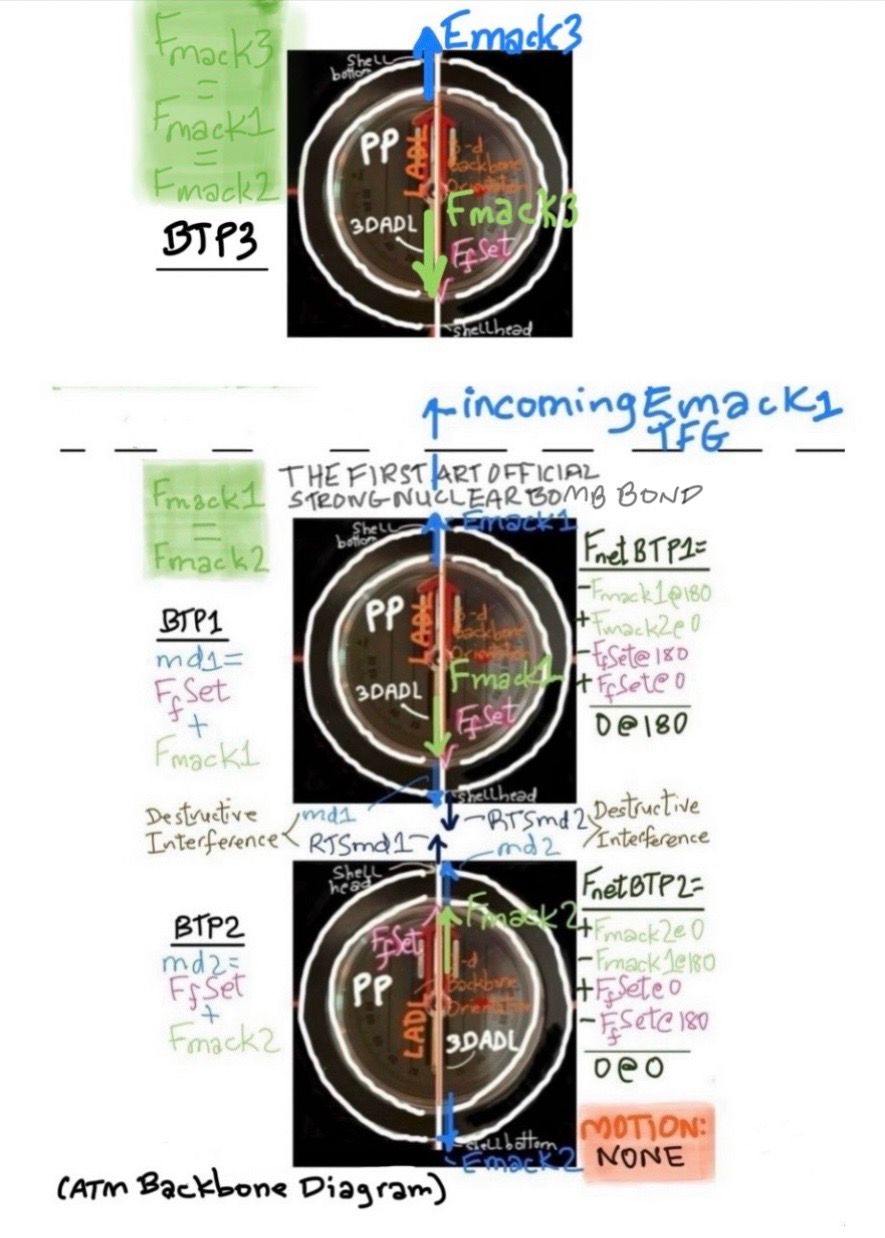
TEST 1 RESULT. BTP3 is going to receive a tax-free gift (“TFG”) of Emack1 smack 😘 on Fmack3—in other words, Emack1 is a TFG to BTP3 (the “TFG-receiver”) from BTP1 (the “TFG-giver”)—but that won’t have any effect on BTP3’s APPROACH SPEED or FORCE.
There are TWO REASONS WHY BTP3’s receipt of the Emack1 smack 😘 on Fmack3 won’t alter BTP3’s APPROACH SPEED or FORCE.
Reason 1 is because there’s no way, no how for a 3-d Emack TFG to ALTER A BTP’S EXPERIENCE OF THE THRUST OF FfSet; there’s no TFG in the universe that can “TOUCH” THE THRUST THAT IS CAUSING BTP3’s FfSet—which is causing BTP3’s APPROACH SPEED and FORCE—because THE THRUST that is causing BTP3’s FfSet is ETERNALLY ACCOUNTED-FOR IN BTP1’s SNOWMAN OF GOD, and it’s ALL THE WAVE-LENGTH FORCE of the EM Spectrum.
Emack1 TFG: [*smacking 😘 on Fmack3*] The universe is talking to us right now, you just gotta listen.
BTP3’s FfSet: [*MC Hammering to the universe*] U can’t touch this.
Reason 2 is because BTP is moving at the speed of light, and that’s all the speed it’s possible to get; “multiple lights,” e.g., Fmack3 + FfSet, in one place doesn’t increase the speed of something moving at the speed of light in that place!
So to repeat: BTP3’s APPROACH SPEED and FORCE are unaffected by receiving the Emack1 TFG smack 😘 on Fmack3 because BTP3 is already moving at the speed of light under power of FfSet.
End of TEST 1!
☕️ ☕️ ☕️ ☕️ ☕️ ☕️ ☕️ ☕️ ☕️ ☕️ ☕️ ☕️
TEST 1 REDUX. OK fine, BTP3’s APPROACH SPEED and FORCE are unaffected by the Emack1 TFG smack 😘 on Fmack3, but what ACTUAL EFFECT, if any, does the TFG have on BTP3’s WPD???
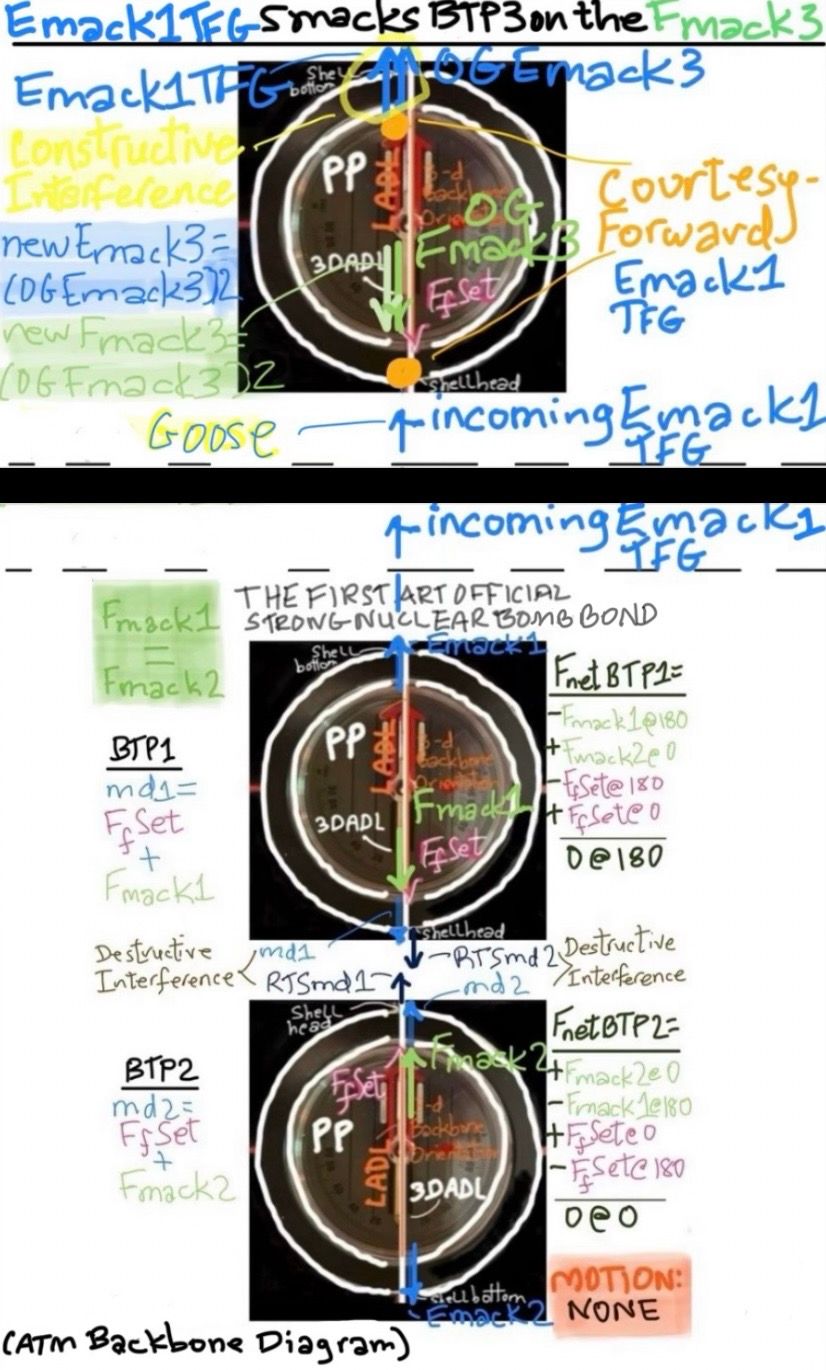
TEST 1 REDUX RESULT. The Emack1 TFG smack 😘 on Fmack3 will give BTP3 a 3-d WPD Goose 🪿 by INTERFERING CONSTRUCTIVELY with Emack3—which, since Emack1 = Emack3, means that the thrust of Emack3 will be DOUBLED—and that will DOUBLE THE WPD of BTP3.
Further explanation:
RECALL (see Topic 4) that a BTP’s 3-d SheLL has an ENERGY-MAIL BOX at each 3-d direction on the SheLL Compass.
The ENERGY-MAIL BOX functions to RETURN-TO-SENDER (RTS) any 🛳️ mass deposit (“md”) received from a Moving Service Provider, with the dual effects of: (i) making an equal-magnitude, opposite-direction wave-energy tax payment (🌊RTSmd) that satisfies Newton’s Third Law of Motion; and (ii) causing the Moving Service Recipient to experience THRUST by making the RTSmd tax payment.
BUT WE NOTICE that an ENERGY-MAIL BOX couldn’t use the RTS function upon receipt of a TFG smack 😘, because NO TAX IS DUE on a TFG!
But yet the fact remains that it’s PHYSICALLY-IMPOSSIBLE for a naturally EMPTY 3-d SheLL to ACCEPT a TFG!
So therefore IN THE ABSENCE OF A COLLISION—meaning if the ENERGY-MAIL BOX received a TFG, but no Moving Service Provider was yet present in the 3-d direction on the SheLL Compass from whence the TFG was incoming (so the TFG couldn’t “register” as a Moving Service md, which informs us that a TFG CANNOT *BOINK* A 423DCTCC, i.e., CAUSE A DIRECTION CHANGE, but that doesn’t mean that TFGs are benign; “we’re producing a thousand-megawatt surplus”)—the ENERGY-MAIL BOX would have to perform a “COURTESY-FORWARDING” function to ANOTHER ENERGY-MAIL BOX as the means of REJECTING the TFG and DUMPING IT THROUGH AN OPEN DOOR.
So the COURTESY-FORWARDING of a TFG would be like the 3-d SheLL SHOWING THE TFG THE DOOR, by literally directing the TFG to an alternate location of the QOL—and specifically, THE ENERGY-MAIL BOX AT THE OPEN DOOR 180-degrees away on the other side of the 3-d SheLL—thereby SENDING THE TFG ON ITS WAY without giving it any REACTION at all.
To an observer, it would SEEM AS IF the TFG was “PASSING THROUGH” the 3-d SheLL.
That’s surely why modern science tells us that EM wave-energy can “pass through” matter!
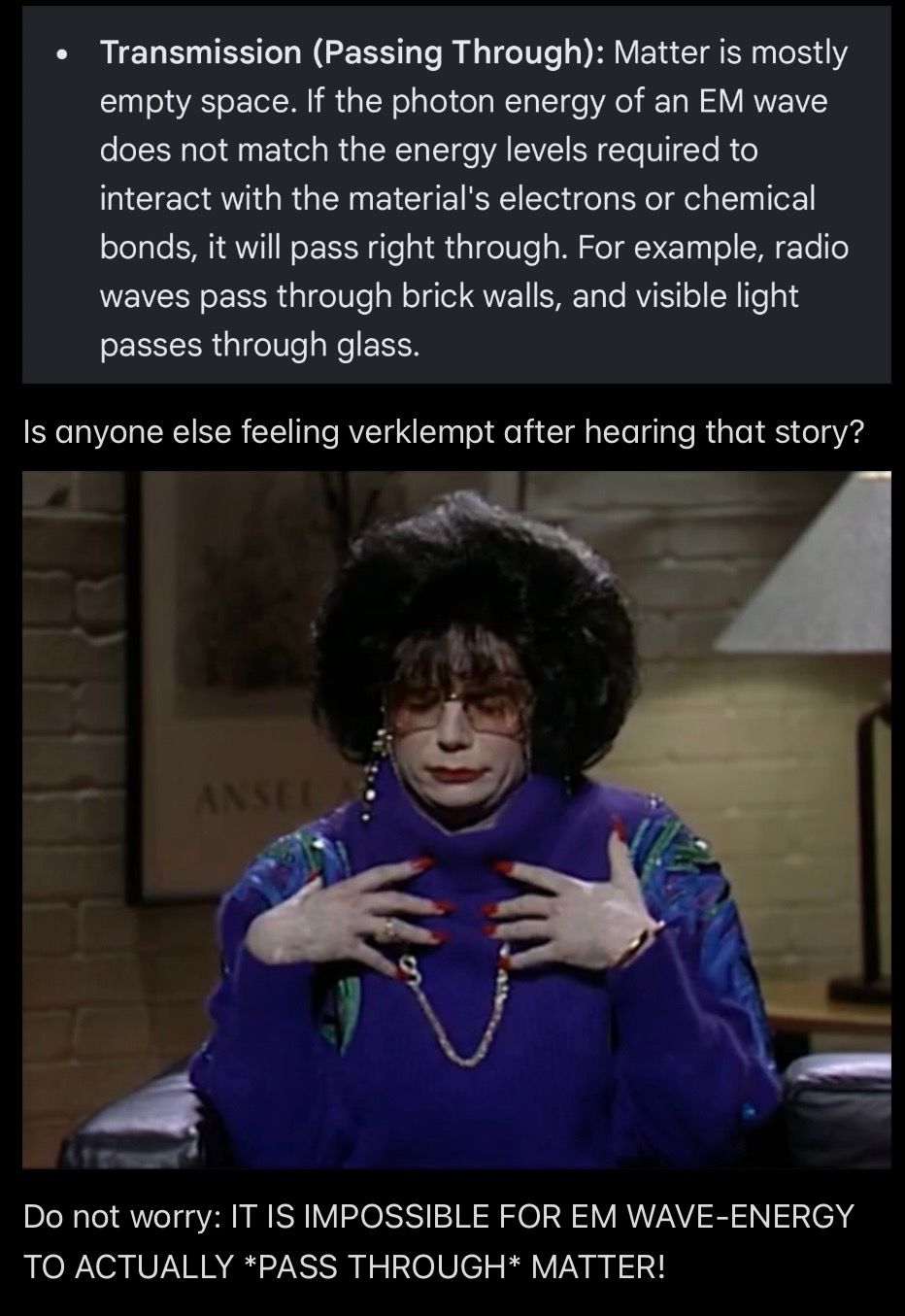
The EM wave-lengths are REALLY BEING COURTESY-FORWARDED by the 3-d SheLL from ONE ENERGY-MAIL BOX (one location of the QOL, where the TFG was incoming to a 3-d SheLL) to ANOTHER ENERGY-MAIL BOX (an alternate location of the QOL, where the TFG was SHOWN THE DOOR on the other side of the 3-d SheLL) along the same line.
And therein lies the genesis of the CONSTRUCTIVE INTERFERENCE event in BTP3’s case: if the TFG Emack smack 😘 is on the Fmack of the TFG-receiver, then the COURTESY-FORWARDING location (the OPEN DOOR) on the other side of the 3-d SheLL is always going to be the exact spot where the TFG-receiver is expressing its own Emack!
And the expression of Emack is what gives the TFG-receiver the THRUST that creates the WPD effect.
So then at that juncture, THE COURTESY-FORWARDED TFG and the TFG-receiver’s own Emack are going to be TRAVELING IN THE SAME DIRECTION ALONG THE SAME LINE.
Ergo, WHATEVER WAVE-LENGTHS (in whatever quantities) THE COURTESY-FORWARDED TFG and the TFG-receiver’s own Emack have in common will CONSTRUCTIVELY INTERFERE, giving the TFG-receiver a WPD GOOSE 🪿.
OTOH, if the courtesy-forwarded TFG Emack and the TFG-receiver’s own Emack DO NOT HAVE ANY WAVE-LENGTHS IN COMMON, then the TFG will have NO EFFECT WHATSOEVER on the TFG-receiver.
Likewise, if the TFG Emack smacks the TFG-receiver along any line OTHER THAN the TFG-receiver’s WPD line—*even if* the TFG Emack and the TFG-receiver’s own Emack DO, IN FACT, HAVE WAVE-LENGTHS IN COMMON—then the TFG will have NO EFFECT WHATSOEVER on the TFG-receiver.
This is because EM wave-lengths are NOT RELATIVE-TO each other, so therefore the only possible REASON that EM wave-lengths would ever have for “interacting” would be if THE SAME WAVE-LENGTHS WERE ASKED TO BE IN THE SAME POSITION ALONG THE SAME LINE, and that could not happen in the TFG smack 😘 case unless the TFG was delivered smack dab on the TFG-receiver’s Fmack, in which case the SAME WAVE-LENGTHS WOULD BE MOVING IN THE SAME DIRECTION ALONG THE SAME LINE, resulting in CONSTRUCTIVE INTERFERENCE between them (and a WPD Goose for the TFG-receiver.)
QUESTION: What if the TFG-giver’s Emack had the same wave-lengths (in the same quantities) as the TFG-receiver’s Emack, but the TFG was actually a smack 👋 in the TFG-receiver’s peachy 🍑 Emack emissary? In other words, WHAT IF THE SAME WAVE-LENGTHS WERE ASKED TO MOVE IN OPPOSITE DIRECTIONS ALONG THE SAME LINE?
ANSWER: The EXCHANGE of identical Emack TFGs would result-in DESTRUCTIVE INTERFERENCE ☠️ of the same wave-lengths in the same quantities, and therefore would reduce both WPDs to naught, leaving the WPD-owners POWERLESS.
But again: UNLESS AN Emack TFG SMACKS THE TFG-RECEIVER ON THE WPD LINE *and* the TFG-receiver’s WPD has wave-lengths in common with TFG-giver’s WPD, NOTHING WILL HAPPEN; THE TFG WILL MERELY BE COURTESY-FORWARDED BY THE TFG-receiver AND CONTINUE ON ITS WAY IN THE SAME DIRECTION ALONG THE SAME LINE, *as if* it PASSED THROUGH the TFG-receiver.
Now let’s return to the facts with which we’re dealing: BTP3 received an Emack1 TFG smack 😘 on the Fmack3, and as a result, BTP3’s WPD got a WPD-doubling Goose 🪿when the Emack1 TFG was COURTESY-FORWARDED by the ENERGY-MAIL BOX at 0-degrees on the SheLL3 Compass to the ENERGY-MAIL BOX at BTP3’s OPEN BACK DOOR (at 180-degrees on the SheLL3 Compass), where BTP3 emits Emack3, causing the Emack1 TFG and Emack3 to CONSTRUCTIVELY INTERFERE.
What happens to BTP3 and BTP1 next DEPENDS-ON WHAT ELSE IS “GOING ON” with them.
And again, we know that BTP3 is already moving at the speed of light under power of FfSet, so therefore the WPD Goose 🪿 won’t change BTP3’s APPROACH SPEED or FORCE as it moves toward BTP1, which is A SITTING DUCK, literally just sitting there in an ongoing head-on collision with BP2.
End of TEST 1 REDUX!
☕️ ☕️ ☕️ ☕️ ☕️ ☕️ ☕️ ☕️ ☕️ ☕️ ☕️ ☕️
TEST 2. What would happen if BTP3 with (WPD3)x2 ON THE LOOSE IN THE UNIVERSE ACTUALLY COLLIDED with BTP1 along the same 3DADL?
TEST 2 RESULT. Indeterminate in one instant.
In other words, whatever happens, WE NOTICE that this collision event CANNOT BE RESOLVED IN A WAY THAT ENABLES THE BTPs TO “MOVE ON” IN THE INSTANT AFTER THE COLLISION, because there is NO WAY to find the NEW FnetBTP2 until AFTER BPT1 APPLIES THE NEW FnetBPT1 to BTP2; it’s a matter of CAUSE AND EFFECT.
It’s RUBE-GOLDBERG-ESQUE!
In fact, the initial collision event (let’s call it the “RUBE-GOLDBERG COLLISION CHAIN,” or “RGCC”) WILL TAKE AT LEAST TWO INSTANTS to complete, and we are going to need to FIGURE-OUT THE NET FORCE EXPERIENCED BY EACH BTP AT EACH INSTANT.
Then after we get the BTPs ALL SET—after the SET NET FORCE (“SETFnet”) experienced by each BTP is known—we will see what happens.
The first task is to find the NEW Fnet (let’s call it “RGFnet”) that BTP1 and BTP3 are experiencing.
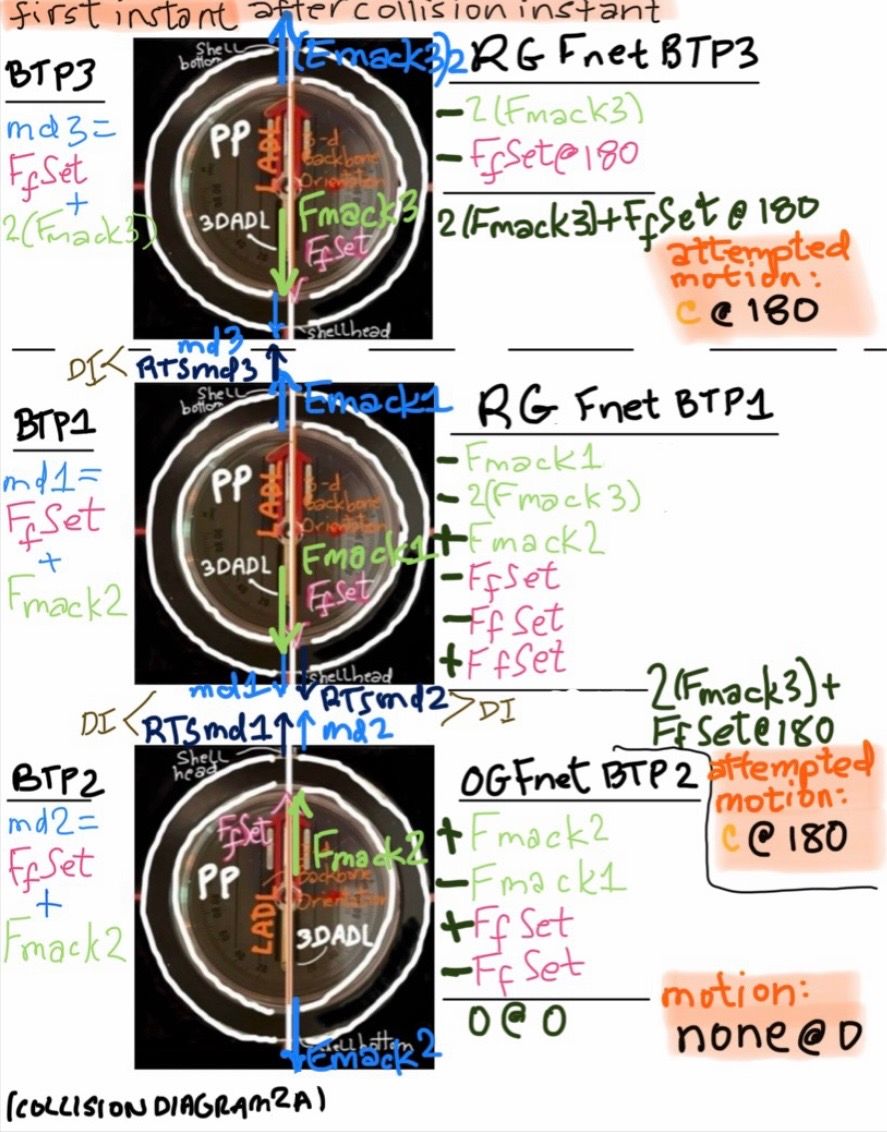
So with reference to COLLISION DIAGRAM 2A, we need to find RGFnetBTP1 and RGFnetBTP3 to get BTPs in motion at the first instant after the collision—when (during the collision) two things are happening:
(i) BTP1 gets “sandwiched” between incoming BTP3 and BTP2 when BTP3 rear-ends BTP1;
and
(ii) BTP2 continues to collide head-on with BTP1 as per THE FIRST ART OFFICIAL STRONG NUCLEAR BOMB BOND ❤️🩹 (see ATM Backbone Diagram.)
Next—with reference to COLLISION DIAGRAM 2B—we need to find RGFnetBTP2 at the second instant after the collision, when two things are happening:
(i) BTP3 continues to rear-end BTP1 as per the first instant (see COLLISION DIAGRAM 2A);
and
(ii) BPT1 collides anew head-on with BTP2.
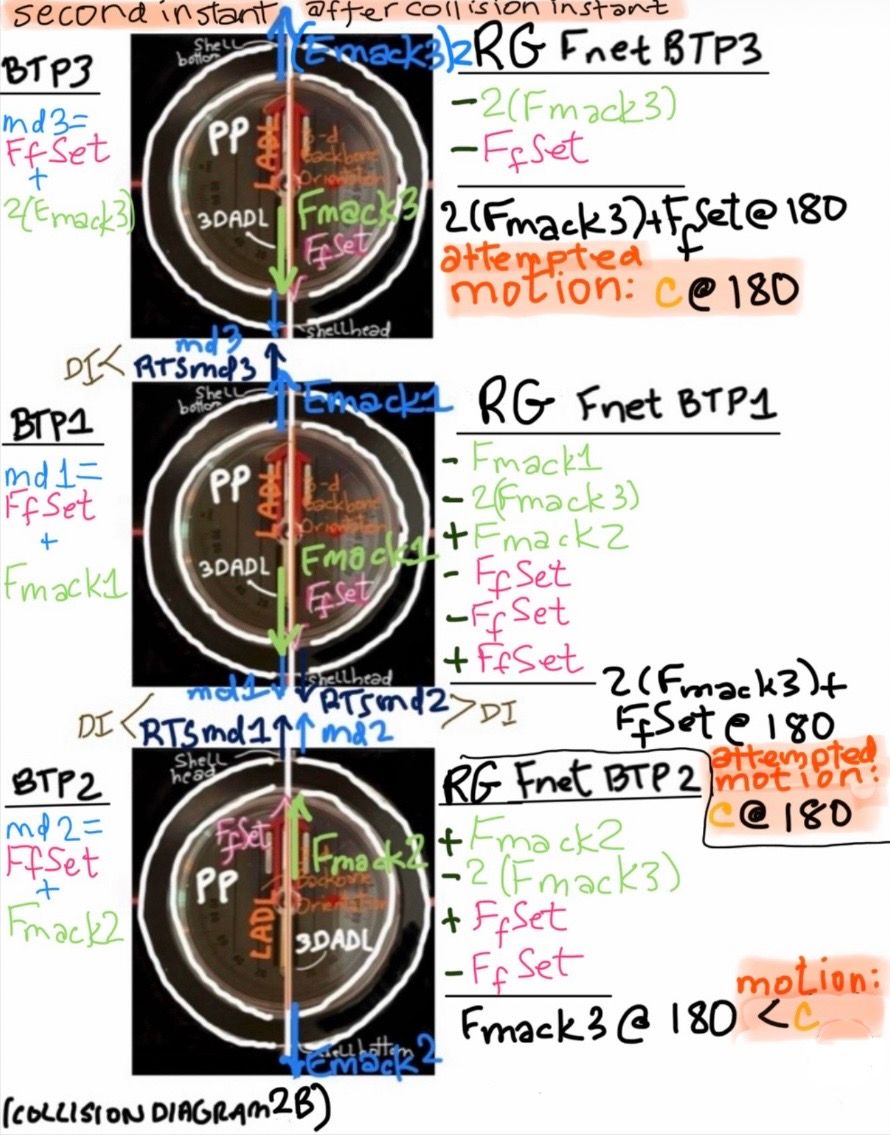
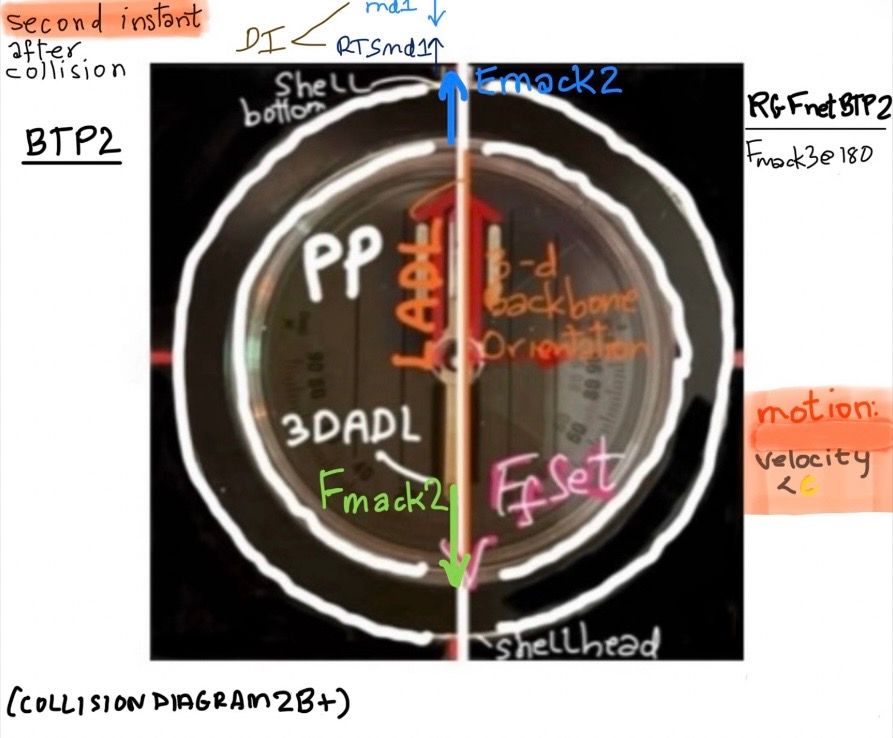
NOTE that as a result of the head-on collision with BTP1, in the second instant, BTP2 will TIP UD—as indicated in COLLISION DIAGRAM 2B+, below—and begin moving at a VELOCITY that is LESS THAN THE SPEED OF LIGHT.
QUESTION: Are we there yet? Are we ALL SET? Did we find SETFnetBTP1, SETFnetBTP2 and SETFetBTP3?
ANSWER: No.
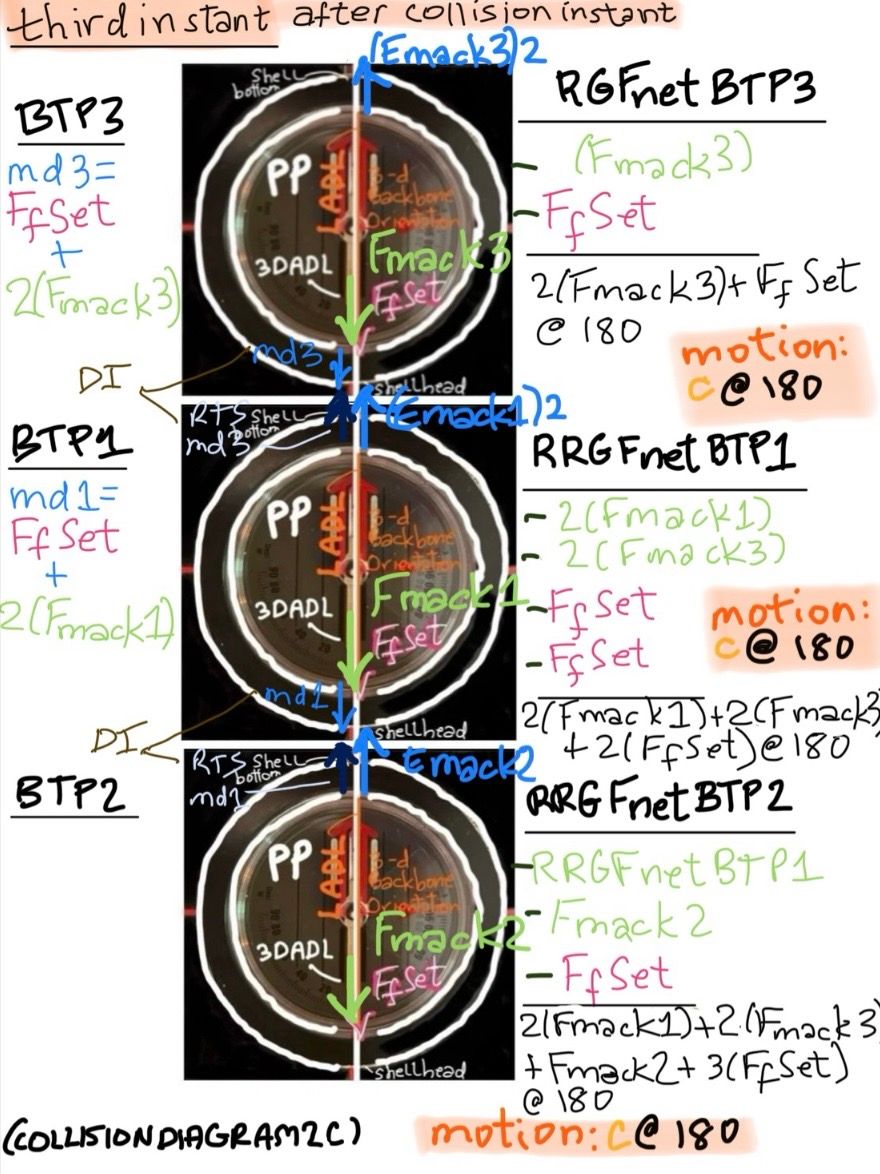
With continuing reference to COLLISION DIAGRAMS 2B and 2B+, we NOTICE two things that will happen in the third instant after the collision:
(i) when BTP2 tips UD in the second instant, BTP1 will receive an Emack2 TFG smack 😘 on Fmack1, which will give BTP1 a WPD Goose 🪿 that will DOUBLE Fmack1 and Emack1 in the third instant;
and
(ii) neither BTP1 nor BTP3 will actually be able to move at the speed of light in the 3rd instant—the speed of BTP1 and BTP3 will be REDUCED, with BTP3 REAR-ENDING BTP1 AGAIN and BTP1 NEWLY REAR-ENDING BTP2—because BTP2 is BLOCKING THE PATH with motion at a speed LESS THAN THE SPEED OF LIGHT.
Ugh.
Now it’s sinking-in that WHAT IS REALLY HAPPENING is that THE COLLISION EVENT IS NOT OVER YET!
Now we’ve got to do a “REVERSE RUBE-GOLDBERG COLLISION CHAIN,” or “RRGCC,” let’s call it, TO GET OUT OF THIS B*TCH.
40 years laaaater….
Top Gun 40th Anniversary Trailer
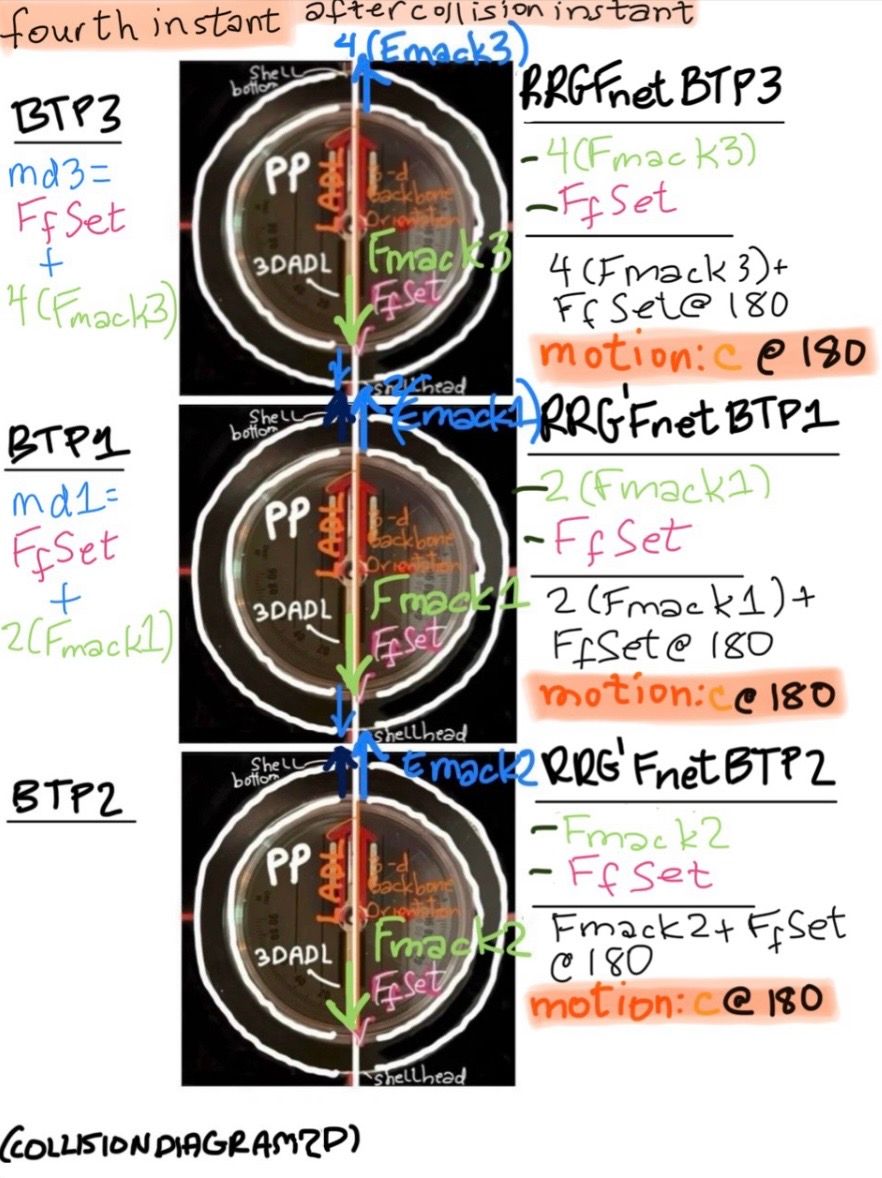
And of course the RRGCC will also TAKE TIME to complete, since a REVERSE RGFnetBTP1 (“RRGFnetBTP1,” let’s call it) has to be determined in instant three BEFORE RRGFnetBTP3 can be determined (in instant four), so therefore we are going to need TWO MORE COLLISION DIAGRAMS (let’s call them COLLISION DIAGRAM 2C and COLLISION DIAGRAM 2D) to analyze the RRGCC.
Cue “The Iron Lotus” IN REVERSE.
And prepare for verklemption with “Inception” vibes.

It’s not, strictly speaking, legal-ese.Initially—with reference to COLLISION DIAGRAM 2C—we need to find RRGFnetBTP1 and RRGFnetBTP2 at the third instant after the collision, when three things are happening:
(i) BTP2 gives BTP1 an Emack2 TFG smack 😘 on Fmack1, so BTP1 gets a WPD GOOSE 🪿, DOUBLING Fmack1 and Emack1;
and
(ii) BTP1 rear-ends BTP2 anew;
and
(iii) BTP3 continues to rear-end BTP1, the same as it did in instant 2 (see COLLISION DIAGRAM 2B.)
Next—with reference to COLLISION DIAGRAM 2D—we need to find RRGFnetBTP3 and RRG’FnetBTP1 and RRG’FnetBTP2 at the fourth instant after the collision, when there is only one thing happening, to wit:
BTP1 is DOUBLING THE MAGNITUDE of the Emack1 TFG smack 😘 on Fmack3, so therefore BTP3 gets ANOTHER WPD GOOSE 🪿 (ON TOP OF THE OG GOOSE 🪿IT WAS GETTING IN THE FIRST THREE INSTANTS), so that’s A DOUBLE GOOSE 🪿🪿, which QUADRUPLES Fmack3 and Emack3 in the fourth instant.
We NOTICE that there are NO COLLISIONS in the fourth instant, because at the end of the third instant, BTP1, BTP2, and BTP3 were all moving at the constant speed of light in the same direction (180-degrees on their own SheLL Compass) along the same line.
Whew!
Now the BTPs are ALL SET!
SETFnetBTP1 = RRG’FnetBTP1;
SETFnetBTP2 = RRG’FnetBTP1;
and
SETFnetBTP3 = RRGFnetBTP3!
All of that was NECESSARY TO SHOW that there’s no possibility of maintaining a STRONG NUCLEAR BOMB BOND ❤️🩹 on the ATM Backbone with anything more or less than TWO BTPs with the same WPD in a head-on collision.
And without a STRONG NUCLEAR BOMB BOND ❤️🩹 on the ATM Backbone, there’s no possibility of BUILDING OR MAINTAINING AN ATM.
Now we’ve deduced ONE PRE-CONDITION of ATM formation, to wit: the ATM Backbone must be PROTECTED; we can’t go through that again!
End of TEST 2!
☕️ ☕️ ☕️ ☕️ ☕️ ☕️ ☕️ ☕️ ☕️ ☕️ ☕️ ☕️
TEST 3. Referring-to the ATM Backbone Diagram, what would happen if…ANOTHER LONE BTP (“BTP3” with “WPD3”) ON THE LOOSE IN THE UNIVERSE COLLIDED with BTP2 in a 3-d sideways direction along a line of non-zero slope (see Article 7, TEST-DRIVE 7), while being STEERED at 45-degrees on the BTP SheLL Compass, assuming that WPD3 = WPD1 = WPD2?
TEST 3 RESULT. Impossible motion does not compute; we are missing mission-critical information.
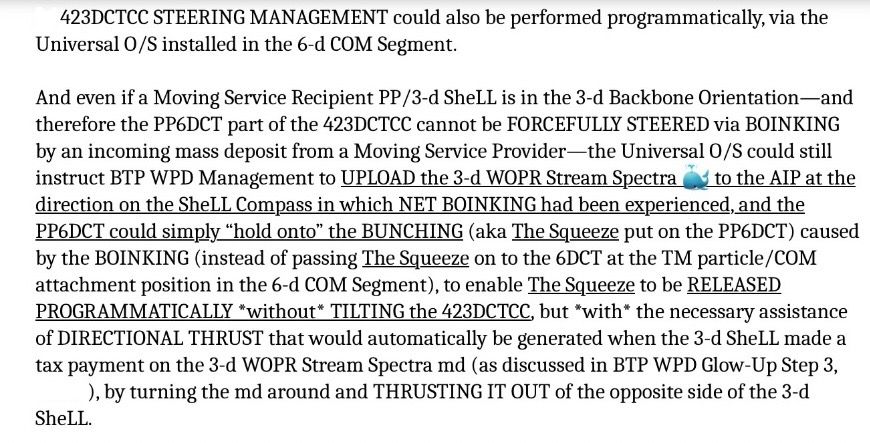
We know that all BTPs are MUTUALLY-RELATIVE to each other, which means that BTP1 and BTP2 can EXPERIENCE Moving Services in the 3-d sideways directions when their 423DCTCC is BOINKED by an incoming 🛳️ md from a Moving Service Provider, even though their 423DCTCC cannot TILT out of the 3-d Backbone Orientation along the 3DADL.
RECALL from Topic 3, BTP WPD Glow-Up Step 2:
The point is that we already know that it’s PHYSICALLY-POSSIBLE for the ATM Backbone to move, but before we can amass any more know-how on that topic, we have to solve the problem of getting CONFIDENCE IN THE INTEGRITY OF THE ATM BACKBONE STRUCTURE, which is what we’re doing now.
So here’s the plan: we’re going to defer the discussion of the ATM Backbone moving process (see Article 9, Part III), and for now, simply refer-to the “ATTEMPTED MOVEMENT” of the BTPs in the ATM Backbone.
Returning to the discussion of TEST 3, see COLLISION DIAGRAMS 3A, 3B, and 3C, illustrating the RUBE-GOLDBERG COLLISION CHAIN (RGCC) and the REVERSE RUBE-GOLDBERG (RRGCC) for the COLLISION EVENT between BTP3 and BTP2.
The RGCC takes one instant after the collision instant—the first instant, depicted in COLLISION DIAGRAM 3A—to complete, during which time RGFnetBTP2 must be determined before RGFnetBTP1 can be known.
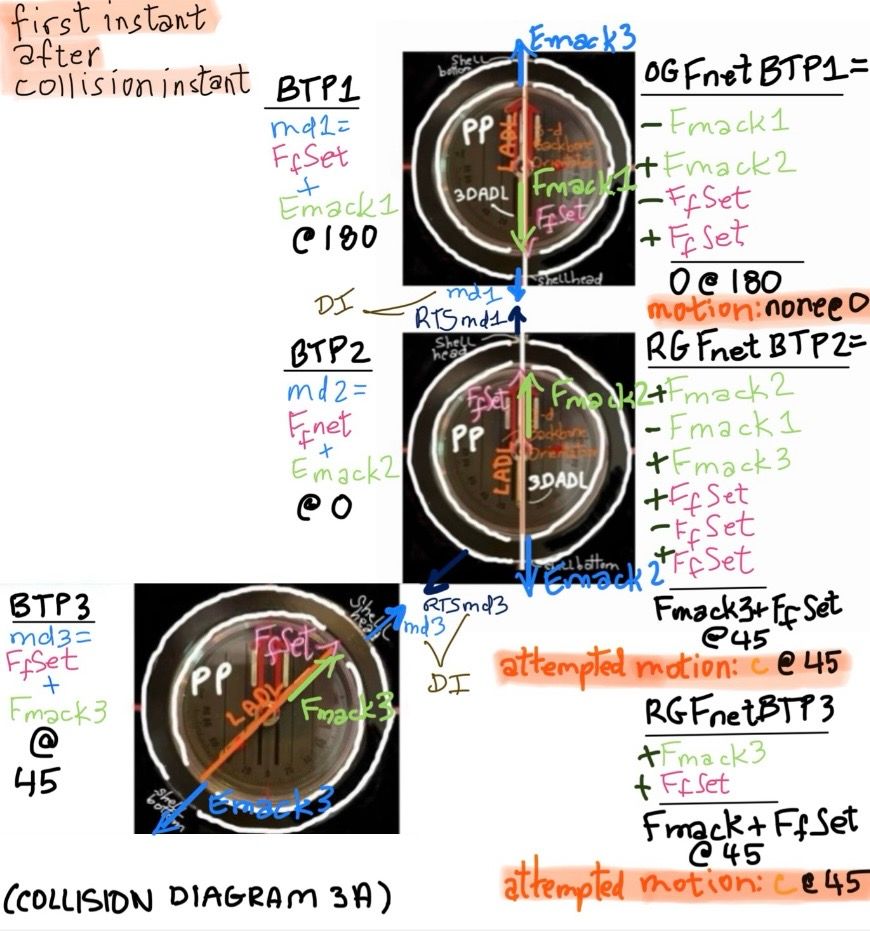
Then the RRGCC also takes one instant—the second instant, depicted in COLLISION DIGRAM 3B—to complete, during which time RGFnetBTP1 must be determined before RRGFnetBTP2 and RRGBFnetBTP3 can be known.
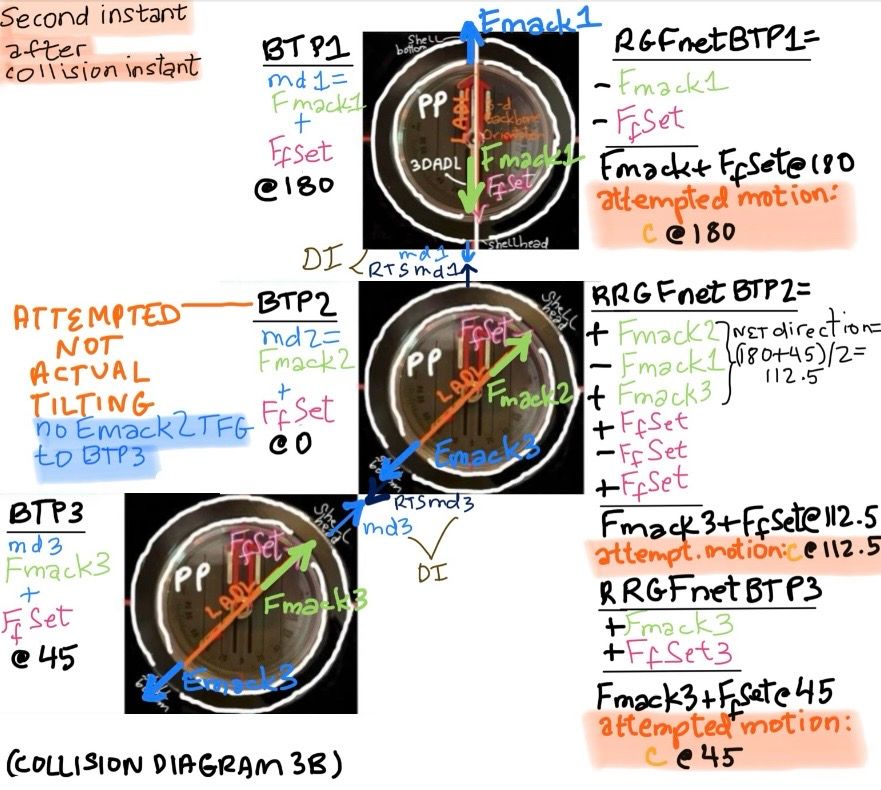
The BTPs are ALL SET in the third instant, depicted in COLLISION DIAGRAM 3C, where SETFnetBTP1 = RGFnetBTP1, and SETFnetBTP2 = RRGFnetBTP1, and SETFnetBTP3 = RRGFnetBTP3.
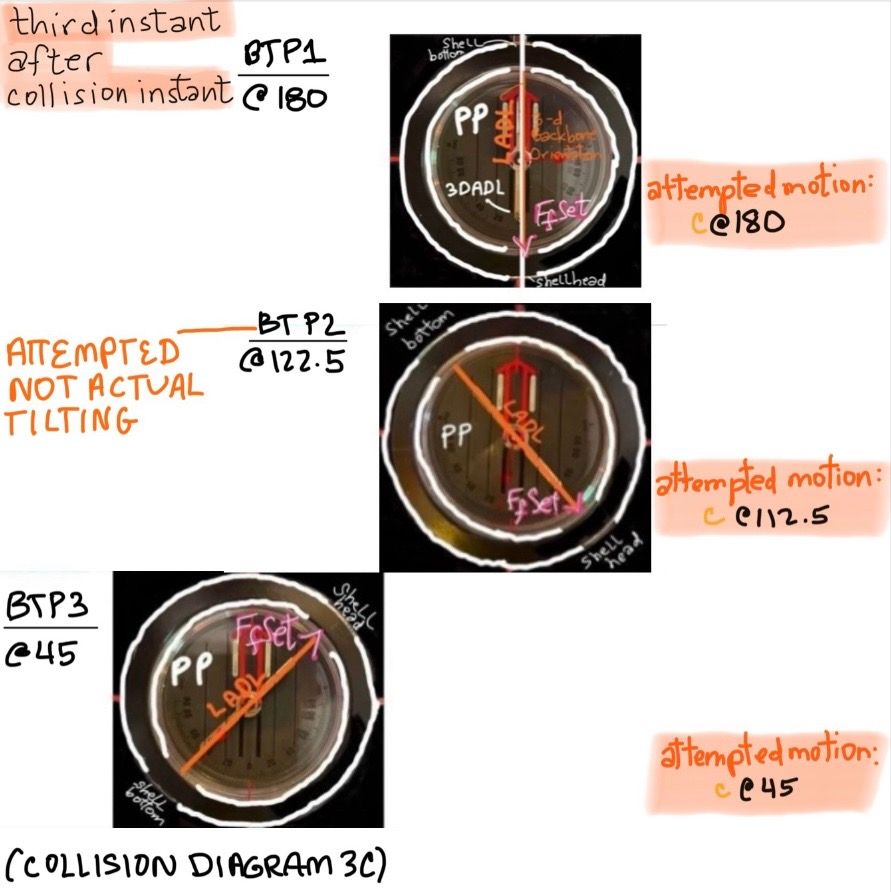
I know, I know: there’s definitely something wrong with that picture!
But we don’t have to panic, because TECHNICALLY, WE HAVE NOT GOTTEN ANY THING MOVING YET.
Still, it’s easy to see “where things went South,” because that’s the exact instant—the second instant—when we concluded that BTP1 and BTP2 should attempt to go South.
🙃
Ergo, CLEARLY, we are missing some information *in the second instant* that we NEED TO KNOW, because EVEN IF BTP1 AND BTP2 COULD “GO SOUTH” *TOGETHER* (IN THE 112.5-degree DIRECTION) ON THE BTP2 SheLL COMPASS in the third instant, that movement would not “track” in the context of BTP3 being a *NORTHBOUND* Moving Service Provider!
Think about it: in no universe does the application of ONE UNBALANCED PHYSICAL FORCE that is TRYING TO GET A STATIONARY OBJECT TO MOVE AT 45-DEGREES *NORTH* on the stationary object’s own compass SUCCEED AT MAKING THE STATIONARY OBJECT MOVE AT 112.5 DEGREES *SOUTH* on the stationary object’s own compass.
So now WE SEE THE PROBLEM, to wit: in every case of BTP2 experiencing an UNBALANCED Moving Service in a 3-d sideways direction, OUR ILLOGIC has the power to DESTROY THE ATM BACKBONE in theory, by “turning BTP1 into a Moving Service Provider” to BTP2, in contradiction to the facts with which we are working.
In fact, THAT SHIP HAS ALREADY SAILED—in other words, the issue of BTP1’s identity has been SETTLED, and now, *unless BTP1 changes direction* (which won’t happen unless the ATM Backbone receives a Moving Service), BTP1 is merely A PASSIVE PASSENGER OF BTP2, NOT BTP2’s “ENGINE”—because BTP1 and BTP2 are in an *unbreakable* (by any 3-d sideways direction Moving Service) head-on collision in the 3-d Backbone Orientation along the same 3DADL with BTP1 on top of BTP2.
Ergo, we cannot allow BTP3 to “break” BTP1 and BTP2’s head-on collision IN THEORY.
That’s what we were missing in the second instant that WE NEEDED TO KNOW, to wit: the fact that BTP3 does not have the ability—it’s ILLEGAL, it VIOLATES THE LAWS OF PHYSICS to “break” the ATM Backbone with a Moving Service in a 3-d sideways direction.
Ergo, *if* our final ATM design PROTECTS (i.e., NATURALLY, INHERENTLY, and PHYSICALLY PREVENTS) the ATM Backbone from being BROKEN, *then* WE ARE MANDATED BY LAW to treat the ATM Backbone as A SINGLE OBJECT, which is ENABLED TO MOVE (somehow, which is our job to figure out in Article 9, Part III) based-on THE MAGNITUDE AND DIRECTION OF THE NET FORCE EXPERIENCED BY BTP2.
End of TEST 3!
☕️ ☕️ ☕️ ☕️ ☕️ ☕️ ☕️ ☕️ ☕️ ☕️ ☕️ ☕️
TEST 3 REDUX. Now that we know that it’s PHYSICALLY-IMPOSSIBLE for BTP3 to “break” the ATM Backbone by rendering a Moving Service to BTP2 in a 3-d sideways direction, we can re-do the relevant COLLISION DIAGRAMS from TEST 3—we’ll call the new illustrations COLLISION DIAGRAM 3A’ and COLLISION DIAGRAM 3B’—treating the ATM Backbone as a two-BTP object with a center-of-mass (“COM.”)
TEST 3 REDUX RESULT.
Now we could say that the ATM Backbone is an ATM with mass = 2 BTPs, and it’s “represented” by the Atomic COM (“ACOM”), aka BTP2.
And because we no longer need to “recognize” BTP1 or BTP2 individually—but we do need to CONTINUE TRACKING THE MAGNITUDE AND DIRECTION OF SETFnetBTP2—we can simply OVERLAY A COMPASS NEEDLE (labeled “Fx”) on BTP2 to identify the ACOM’s EXPERIENCE of SETFnetBTP2, which we could simply call “SETFx.”
SETFx = ZERO @ ZERO-degrees on the ACOM SheLL Compass, in the absence of a COLLISION with a Moving Service Provider, e.g., a lone BTP on the loose in the universe, such as BTP3.
Now we’re cooking with EM energy!
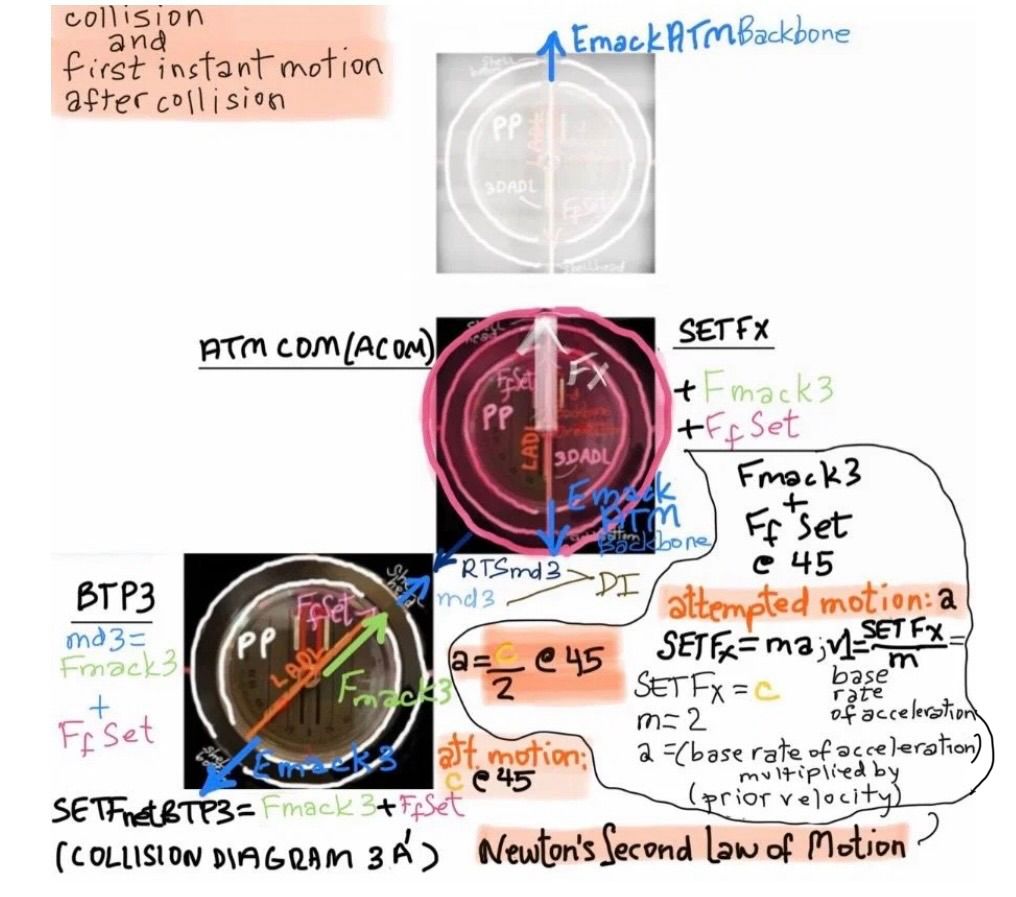
NOTICE that to determine the attempted motion—the attempted VELOCITY, in other words—of the ATM, we have to account-for the MASS of the ATM, which is two (2) BTPs.
And we know that Newton’s Second Law of Motion, SETFx = mass x acceleration (SETFx = ma), governs motion in the case of a Moving Service Provider ramming into a Moving Service Recipient, which experiences NET FORCE (“SETFx” is what we’re calling ACOM’s NET FORCE experience) as a result.
a = v², which means (the base rate of acceleration, or if no acceleration, then 1) MULTIPLIED BY (the prior-velocity in same direction)
If the Moving Service Recipient CHANGES DIRECTION, then its VELOCITY RE-SETS, so in that case acceleration can’t even theoretically occur; acceleration cannot happen in one instant!
For acceleration to occur, there must be a second experience of NET FORCE in the SAME DIRECTION in a subsequent instant.
To repeat: ACCELERATION CAN ONLY HAPPEN IF THE MOVING SERVICE ALREADY HAD VELOCITY IN THE SAME DIRECTION AS SETFx.
So the base rate of acceleration is the velocity in the first instant—before acceleration —which is determined by Newton’s First Law of Motion, SETFx = mv
We know that SETFx = Fmack3 + FfSet is experienced as SETFx = c, because c is the maximum wave-length force in Reality, i.e., all the wave-lengths in the EM Spectrum),
and
m = 2
Substituting, we find that the attempted velocity in the first instant = c/2, at 45-degrees on the ACOM SheLL Compass.
In this case, during the COLLISION INSTANT, the DIRECTION of OG Fx changed from ZERO on the ACOM SheLL Compass to 45-degrees on the ACOM SheLL Compass, so therefore ACOM can’t accelerate in the FIRST INSTANT AFTER THE COLLISION, it simply gets a new ATTEMPTED motion, i.e., ATTEMPTED velocity, c/2.
Then in the SECOND INSTANT after the collision, the ACOM could, IN THEORY, accelerate.
a = (the base rate of acceleration) MULTIPLIED BY (the prior-v in same direction)
a = v1 x v1 = (c/2)², SO WE SEE THAT ACCELERATION IS PHYSICALLY-IMPOSSIBLE because the ACOM’s velocity cannot exceed the speed of light.
Ergo, the ACOM’s ATTEMPTED motion, i.e., ATTEMPTED velocity, remains the same in the second instant.
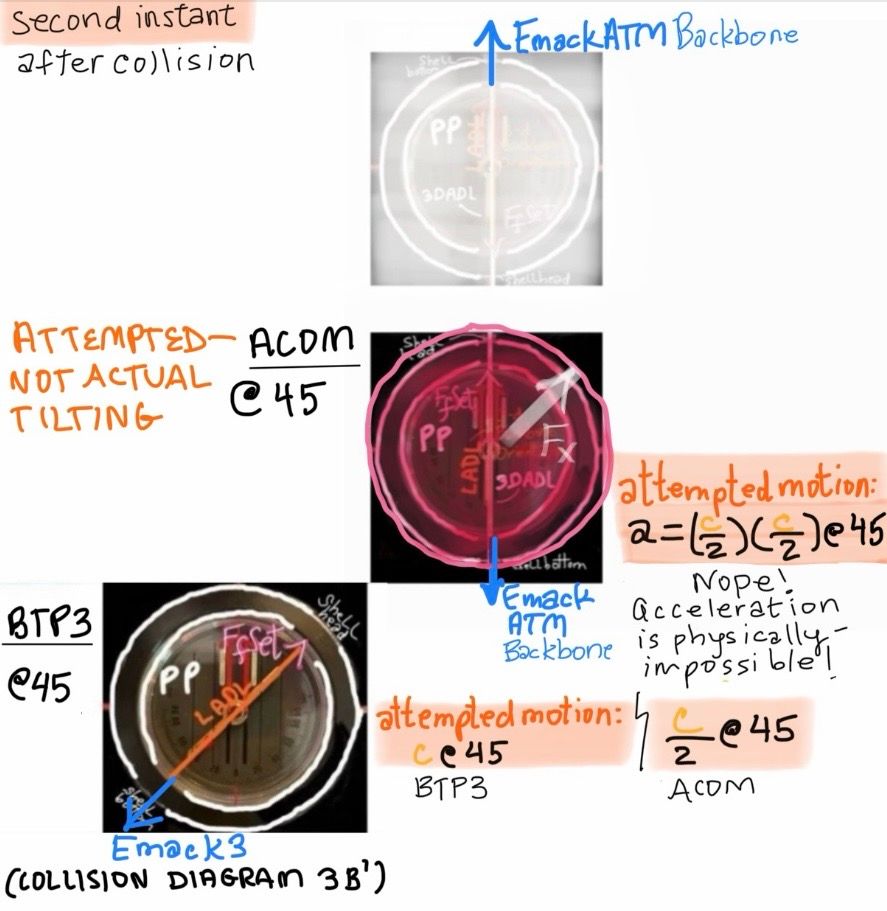
That’s probably where the term “TERMINAL VELOCITY” originated: physical limitations are preventing acceleration.
So we could say that the ACOM has reached TERMINAL VELOCITY because of the MASS of the ATM Backbone.
NOTE, however, that we cannot call the speed of light itself a TERMINAL VELOCITY, since it’s THE LEGAL SPEED LIMIT, and that is A CONSTANT.
End of TEST 3 REDUX!
☕️ ☕️ ☕️ ☕️ ☕️ ☕️ ☕️ ☕️ ☕️ ☕️ ☕️ ☕️
TEST 4. How could the ATM Backbone’s—the ACOM’s—ATTEMPTED (or actual) MOTION be STOPPED without STEERING BTP3 in a different direction?
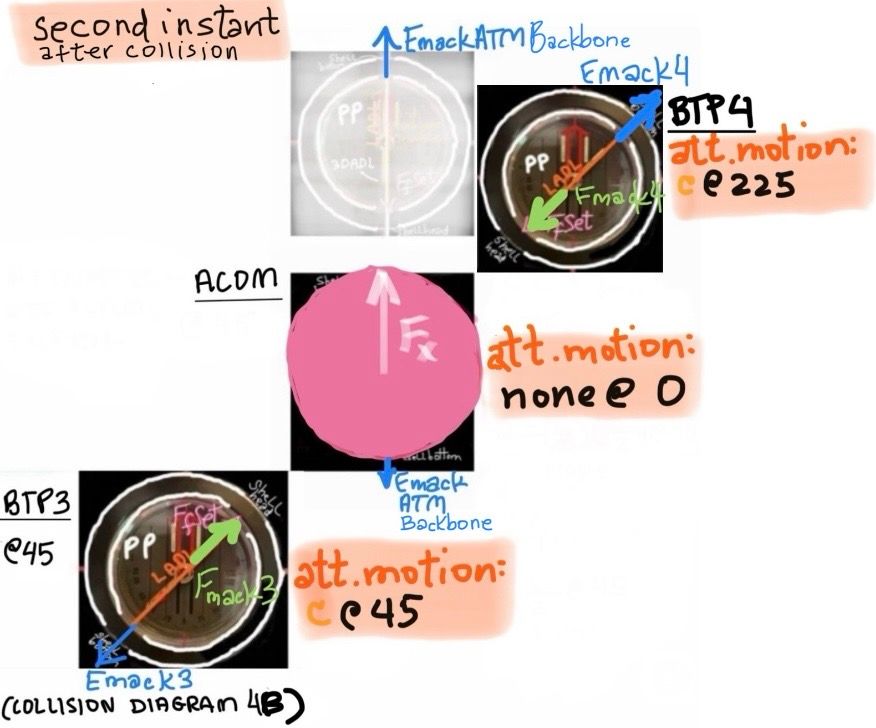
TEST 4 RESULT. As illustrated in COLLISION DIAGRAMS 4A and 4B, Father Time could bring in another BTP (“BTP4,” having the same WPD as BTP3) using FORCELESS STEERING of BTP4, to cause BTP4 to head in the opposite direction (225-degrees on BTP4’s SheLL Compass) along the same 3-d line that BTP3 is heading along, until ACOM was SANDWICHED BETWEEN Moving Service Providers BTP4 and BTP3.
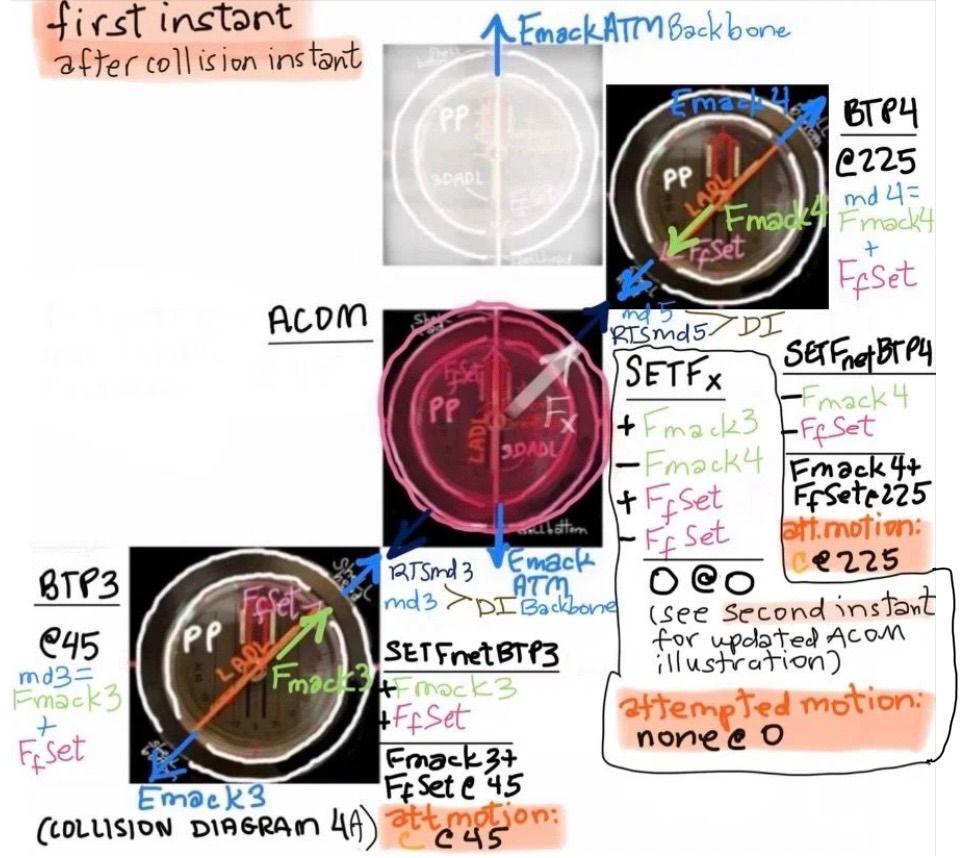
In the first instant after the collision instant, SETFx would return to ZERO at ZERO-degrees on the ACOM SheLL Compass, because RECALL (see Topic 3) that if two Moving Services are act-along the same line, then there are ZERO DEGREES “BETWEEN” (SEPARATING) THEM.
So to repeat: what we have from the ACOM’s perspective as between BTP3 and BTP4 is SETFx = ZERO at ZERO-degrees.
But that’s not what we have from BTP3’s and BTP4’s perspective!
From the POV of BTP2 and BTP3, they are REVVING THEIR LIGHT-SPEED ENGINES!
So when we look at the second instant after the collision instant and beyond, we finally SEE A SOURCE OF EXTERNAL POWER for the ACOM that could be used in ON/OFF manner *if* we could figure-out how to keep BTP3 and BTP4 from LEAVING THE ACOM when they are FORCEFULLY STEERED; a light-speed engine is of no use to the ACOM unless the engine is “on board”!
End of TEST 4!
☕️ ☕️ ☕️ ☕️ ☕️ ☕️ ☕️ ☕️ ☕️ ☕️ ☕️ ☕️
TEST 5. What would the ACOM’s ATTEMPTED VELOCITY be—AND WHAT WOULD HAPPEN TO THE “ON-BOARD” LIGHT-SPEED ENGINES BTP3 AND BTP4—if Father Time brought on-board yet another LIGHT-SPEED ENGINE BTP (“BTP5,” having the same WPD as BTP4), heading in the 270-degree direction on the BTP5 SheLL Compass, to provide a Moving Service to the ACOM?
TEST 5 RESULT. As illustrated in COLLISION DIAGRAM 5A, the ACOM’s ATTEMPTED VELOCITY would be c/4 @ 270, which would be a TERMINAL VELOCITY because acceleration is physically-impossible, exceeding the Legal speed limit of the speed of light.
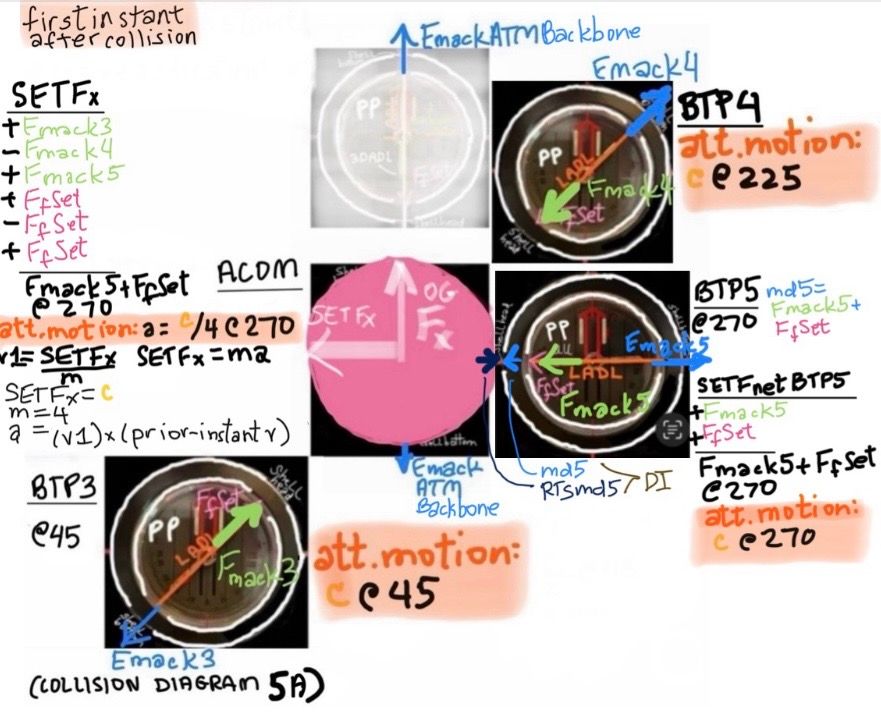
BTP3 and BTP4 would be MASS that the ACOM would have to haul, because BTP3 and BTP4 are not providing unbalanced force to the ACOM, and they are POSITIONALLY RELATIVE-TO ACOM but not vice-versa (in other words, the ACOM and BTP3/BTP4 are in an Absolute-Relative relationship), which means that wherever ACOM goes, BTP3 and BTP4 will automatically follow, because their positions DO NOT EXIST without ACOM’s position existing first!
To repeat this key information essential to ATM-building: light-speed engines BTP3 and BTP4 become PASSIVE PASSENGERS OF ACOM WHEN THEY ARE NOT CAUSING THE ACOM TO EXPERIENCE AN *UNBALANCED* MOVING SERVICE.
So we definitely want to make the connection between BTP3 and BTP4 and the ACOM *permanent* and *unbreakable* by any Moving Service that may be provided to BTP3 or BTP4, because if we can cause that situation to arise, THEN WE CAN—actually, WE MUST, by operation of Law!—TREAT the ATM Backbone PLUS all PERMANENTLY-ON-BOARD BTPs as a MASSIVE OBJECT (an ATM 🏧) with a center-of-mass (the ACOM.)
To repeat this NEW key information essential to ATM-building: *if* the connection between a BTP—a light-speed engine—and the ACOM becomes *unbreakable* (and the connection becomes unbreakable when it’s physically-impossible for a Moving Service provided to the BTP to dislodge the BTP from the mothership ACOM), *then* we can stop “recognizing” the BTP individually.
We’re not in ATM territory yet, but now we see the pattern that we need to implement.
Consider COLLISION DIAGRAM 5B, in which we see that if Father Time brought on-board yet another BTP—“BTP6,” having the same WPD as BTP5, but UD and heading in the 90-degree direction on its own SheLL Compass—and if BTP6 also provided a Moving Service to ACOM, then that would again cause SETFx to return to ZERO at ZERO DEGREES on the ACOM Compass.
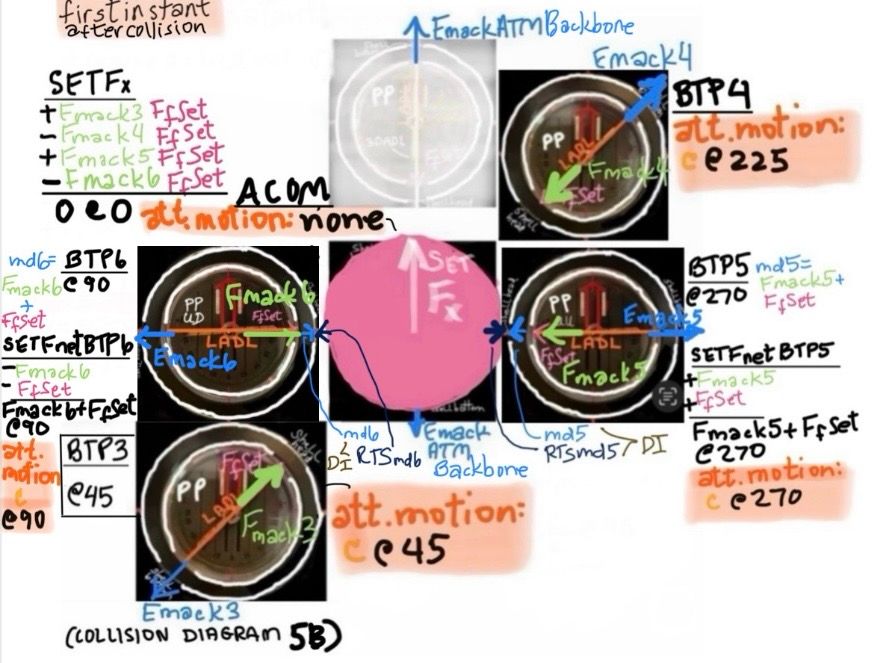
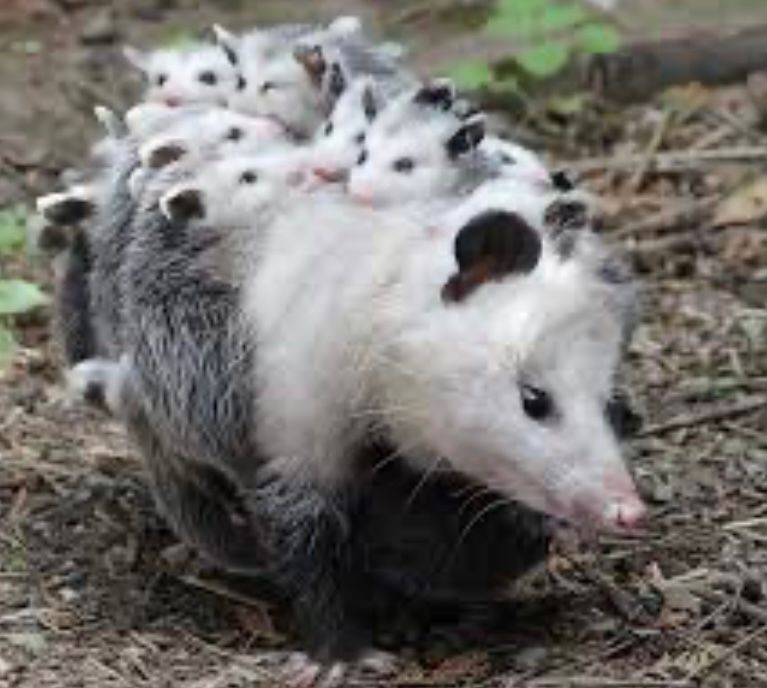
The ATM’s MASS would increase to 6, because both BTP5 and BTP6 would also be “stuck” with the ACOM—so the mothership ACOM’s workload would increase by two masses, since BTP5 and BTP6 would also have to be hauled around (like a mama opossum carrying baby opossums or a mama ATM 🏧 carrying BTPs)—whenever a Moving Service was provided along a different line.
End of TEST 5!
☕️ ☕️ ☕️ ☕️ ☕️ ☕️ ☕️ ☕️ ☕️ ☕️ ☕️ ☕️
In joy,
Frank