Article 11. A Spark: ELEVEN CONSTRAINTS ⛓️
⚠️Under Construction
💼 💼 💼 💼 💼 💼 💼 💼 💼 💼
INDEX
🗂️ PART I. Opening the MOLECULE Case
🗂️ PART II. Introducing CONSTRAINTS ⛓️
🗂️ PART III. Deducing ELEVEN CONSTRAINTS ⛓️ that Govern McMOLECULE CONSTRUCTION
🗂️ PART IV. Making McMOLECULE TEMPLATES from the ELEVEN CONSTRAINTS ⛓️
🗂️ PART V. Adopting Sufficient VOCABULARY and Understanding the LAWS OF PHYSICS Necessary to Do McMOLECULE MOTION ANALYSIS
🗂️ PART VI. Doing McMOLECULE MOTION ANALYSIS to Deduce the TWO TYPES OF BONDS McMOLECULES CAN FORM
💼 💼 💼 💼 💼 💼 💼 💼 💼 💼
🗂️ PART I. Opening the MOLECULE Case
We know that molecules cannot form naturally from Elements—ATMs and TATMs—because (as we learned in Article 9), all Elements are naturally AT-REST.
So therefore the smallest molecules must be CONSTRUCTED WITH INTENTION from the 6th dimension, via FORCELESS STEERING of the BTPs inside of the Elements; FORCELESS STEERING enables an Element to be moved in any 3-d direction on a spherical compass, and also to be rotated around any 3-d direction line on a spherical compass.
So at first, that might seem like a universe-sized blank sheet of paper to fill, and it might feel like an impossible dream to fulfill!
But that’s not because we’re incapable of the task, it’s because we’ve been groomed by modern science—conventional chemistry in particular, including the VSEPR theory—NOT TO RECOGNIZE CONSTRAINTS on MOLECULE SIZE.
Hear hear: “Games People Play” https://www.youtube.com/watch?v=SLi7Ljcy6n8
🎵“Where do we go from here?”🎵
It’s impossible to figure-out where to begin building molecules by following the conventional wisdom, because WE DON’T KNOW WHERE WE’RE GOING—WE DON’T KNOW WHERE “CONVENTIONAL” MOLECULES END—since according to the conventional wisdom, COMPLEX, SINGLE-MOLECULE GEOMETRIES are possible!
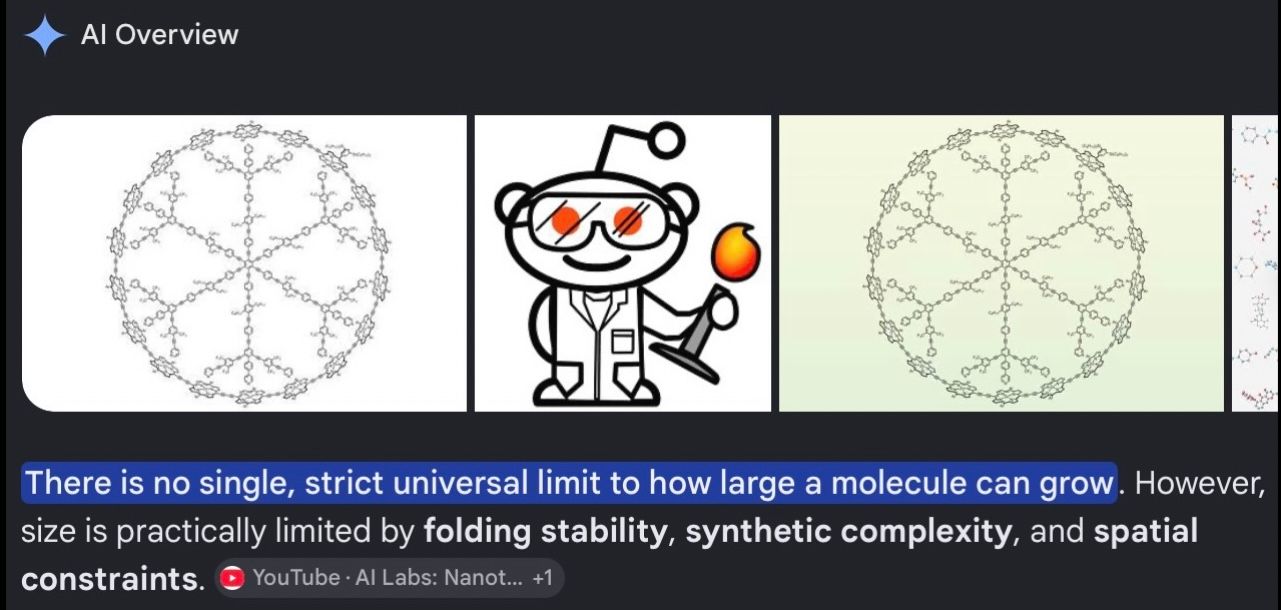
So that’s one significant difference between the TOEWC and conventional chemistry: unlike chemistry, the TOEWC recognizes that STRICT, UNIVERSALLY-APPLICABLE LIMITS—PHYSICAL CONSTRAINTS—govern the possibilities for Elements “sticking together” to form molecules, because molecules must be constructed from Elements, so therefore molecules must behave like Elements, and this means that insofar as it is physically-possible, the structure of a molecule should be correspondent to the structure of an Element.
As discussed in Article 9, all Elements have the same size spherical Element SHELL/Compass, but different Elements have different masses, with an Element’s at-rest Relative Mass—and an Element’s in-motion Relative Mass-Minus—being proportional to an Atomic Number on the Periodic Table.
More specifically, an Atomic Number on the Periodic Table represents the MAGNITUDE of the NORMAL WPD of the BTPs inside of an Element SHELL/Compass.
RECALL from Article 9, PART IV A, Topic 12, Q&A 3:
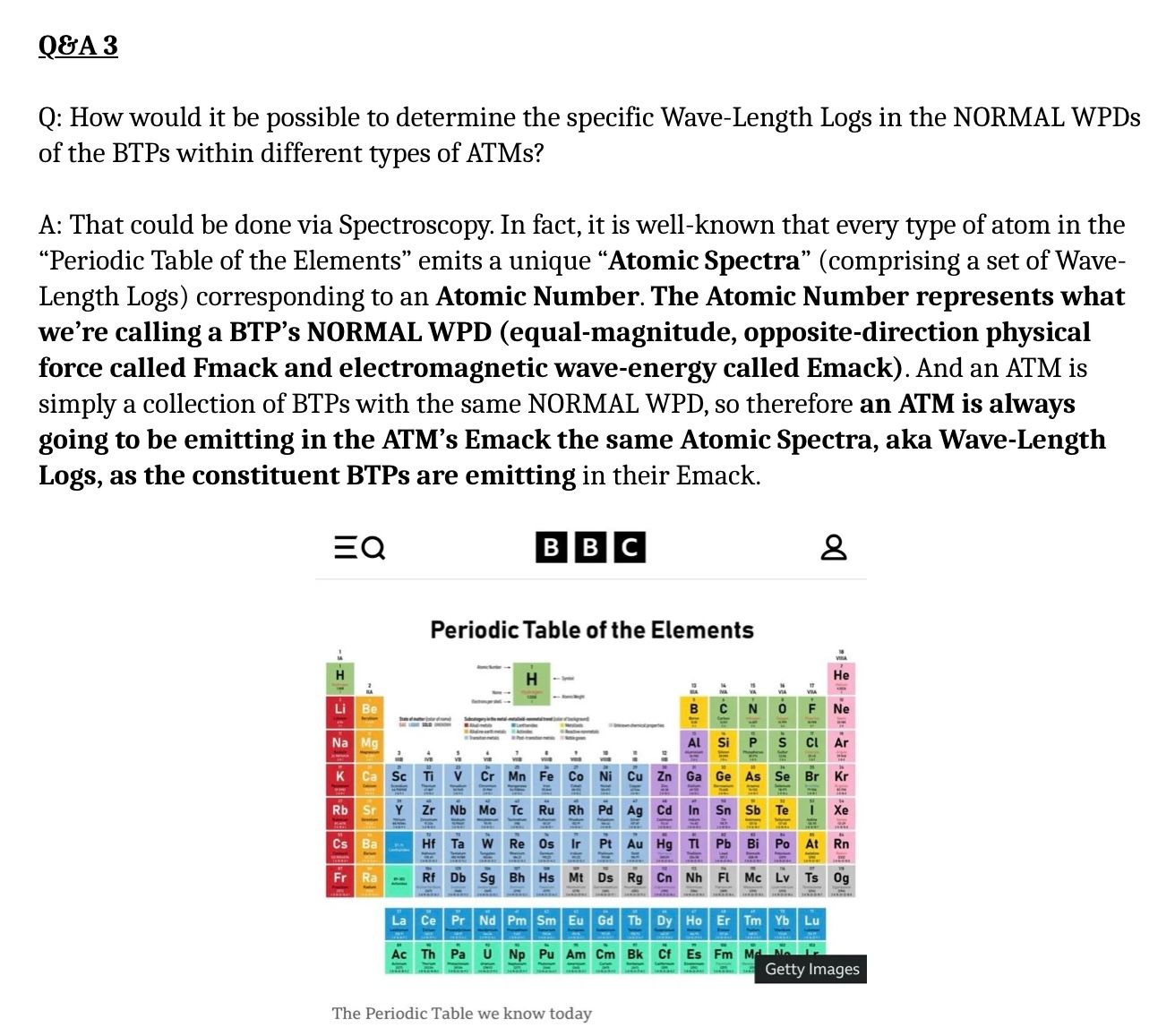
We know that MASS and ELECTROMAGNETIC ENERGY are EQUIVALENT, so therefore the RELATIVE MASS OF ONE ELEMENT will be equal to the TOTAL WAVE-LENGTH FORCE of all the Wave-Length Logs in the Element’s Emack, aka electromagnetic Atomic Spectra.
So for the purposes of MOTION ANALYSIS, the RELATIVE MASS and RELATIVE MASS-MINUS of any given Element can be CALCULATED SIMPLY, as follows:
at-rest Relative Mass in units of WAVE-LENGTH FORCE PER ELEMENT = the Atomic Number of the Element corresponding to the NORMAL WPD of the BTPs inside of the Element *MULTIPLIED BY* 128,882 BTPs per Element;
and
in-motion Relative Mass-Minus in units of WAVE-LENGTH FORCE PER ELEMENT= the Atomic Number of the Element corresponding to the NORMAL WPD of the BTPs inside of the Element *MULTIPLED BY* (128,882 *MINUS* N), where N = the number of WINNING BTPs in the Element that are causing the MACOM at the center of the Element to experience UNBALANCED NET FORCE, i.e., SETFx > 0, and are therefore “carrying their own weight”.
All of this informs us that the TOEWC must recognize two types of molecules:
(1) “McMolecules,” we’ll call them, which are UNBREAKABLE UNITS OF MATTER ANALOGOUS TO ELEMENTS, having fixed geometries and fixed masses (at-rest “McRelative Mass“ and in-motion “McRelative Mass-Minus,” let’s say) with their own SHELL (the “Mc SHELL/Compass,” let’s call it), created by collisions between Elements, which are naturally at-rest, and thus must be FORCELESSLY STEERED into collision positions by the Creator (who ADMINs the Universal O/S installed in every Timeyne) in the 6th dimension, and this means that the SOLE UTILITY of Elements is to form the building-blocks of McMolecules, and therefore McMOLECULES ARE THE SMALLEST UNITS OF MATTER that can ever be encountered;
and
(2) “MegaMolecules,” let’s call them, which are created by collisions between McMolecules that can occur “naturally” (i.e., WITHOUT FORCELESS STEERING into collision positions), and form the basis of massive objects, so therefore at least SOME MegaMolecules must be BREAKABLE, because massive objects made of MegaMolecules are by all means subject to destruction.
Another significant difference between the TOEWC and conventional chemistry is that there are NO ELECTRONS (OR PROTONS OR NEUTRONS!) in the TOEWC.
Nevertheless, both the TOEWC and conventional chemistry must END-UP WITH SIMILAR MOLECULAR GEOMETRIES, because it’s an OBSERVABLE FACT that massive objects are comprised of molecules having specific geometries and material properties.
But we have to learn to walk before we can learn to run—which in this context means that we have to build McMolecules before we can build MegaMolecules or massive objects—so we’re going to devote this entire Article 11 to building McMolecules.
The End of PART I!
🗂️PART II. Introducing CONSTRAINTS ⛓️
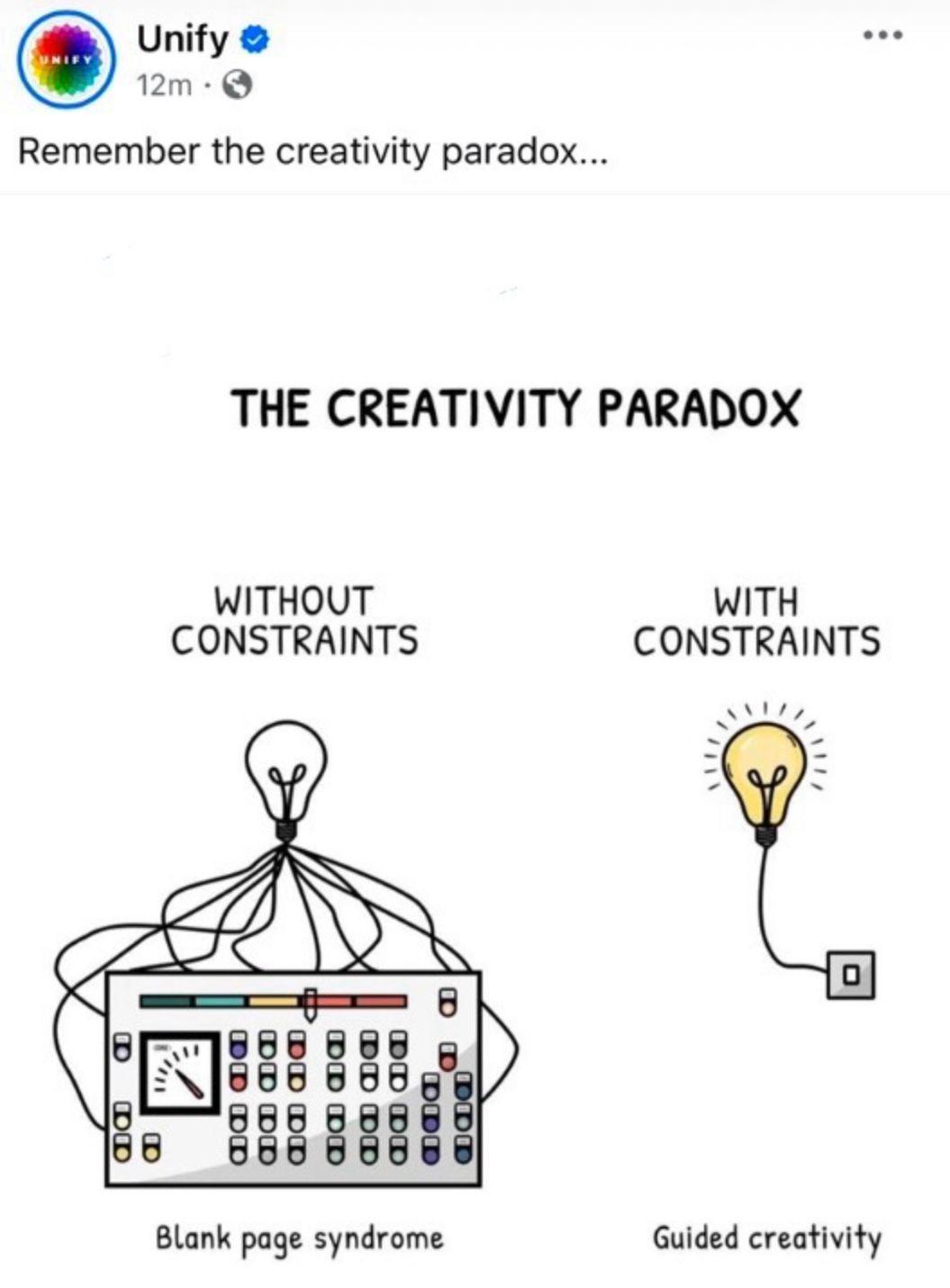
We are NOT INVENTING CONSTRAINTS!
We are only DISCOVERING CONSTRAINTS by acknowledging the FACT (see Article 4 and Article 5) that all matter must have a CREATOR and CONSTRUCTION METHODS; we already know for certain that “automatically collapsing dust-bunnies in place”—letting “nature” take its course 😂, as if there is any such thing as “nature” without a CREATOR—is most assuredly not a valid means of CREATING any FOUNDATIONAL STRUCTURE of matter!
Ergo, WE MUST *DEDUCE* AND *INFER* THE EXISTENCE OF “BEST CONSTRUCTION PRACTICES” that “unnaturally” limit construction methods.
More specifically, our task is to “find” information we already know that is RELEVANT to McMOLECULE CONSTRUCTION, then “translate” that information into the “language” of CONSTRAINTS, aka RULES, that govern McMolecule GEOMETRY/SHAPE and PERFORMANCE.
The End of PART II!
🗂️ PART III. Deducing ELEVEN CONSTRAINTS ⛓️ that Govern McMOLECULE CONSTRUCTION
⛓️ CONSTRAINT 1. McMolecules must all be SPHERICAL with the same 3-ELEMENT DIAMETER, which ensures that all McMolecules take the same amount of time to respond to EXTERNAL MOVING SERVICES
McMolecules must be constructed from Elements, so therefore McMolecules must behave like Elements, and this means that insofar as it is physically-possible, the structure of a McMolecule should be correspondent to the structure of an Element, which is spherical with a central BTP called the MACOM surrounded by BTPs, all encased in an Element SHELL/Compass having a diameter of exactly three BTPs.
We NOTICE that structural correspondence between McMolecules and Elements can easily be accomplished by designating a central Element in each McMolecule (let’s call the central Element the “McMolecule COM,” or “McCOM”), then surrounding it with a spherical Mc SHELL/Compass having a diameter of exactly three Elements, as illustrated in the “McMolecule Diameter Diagram”, below.
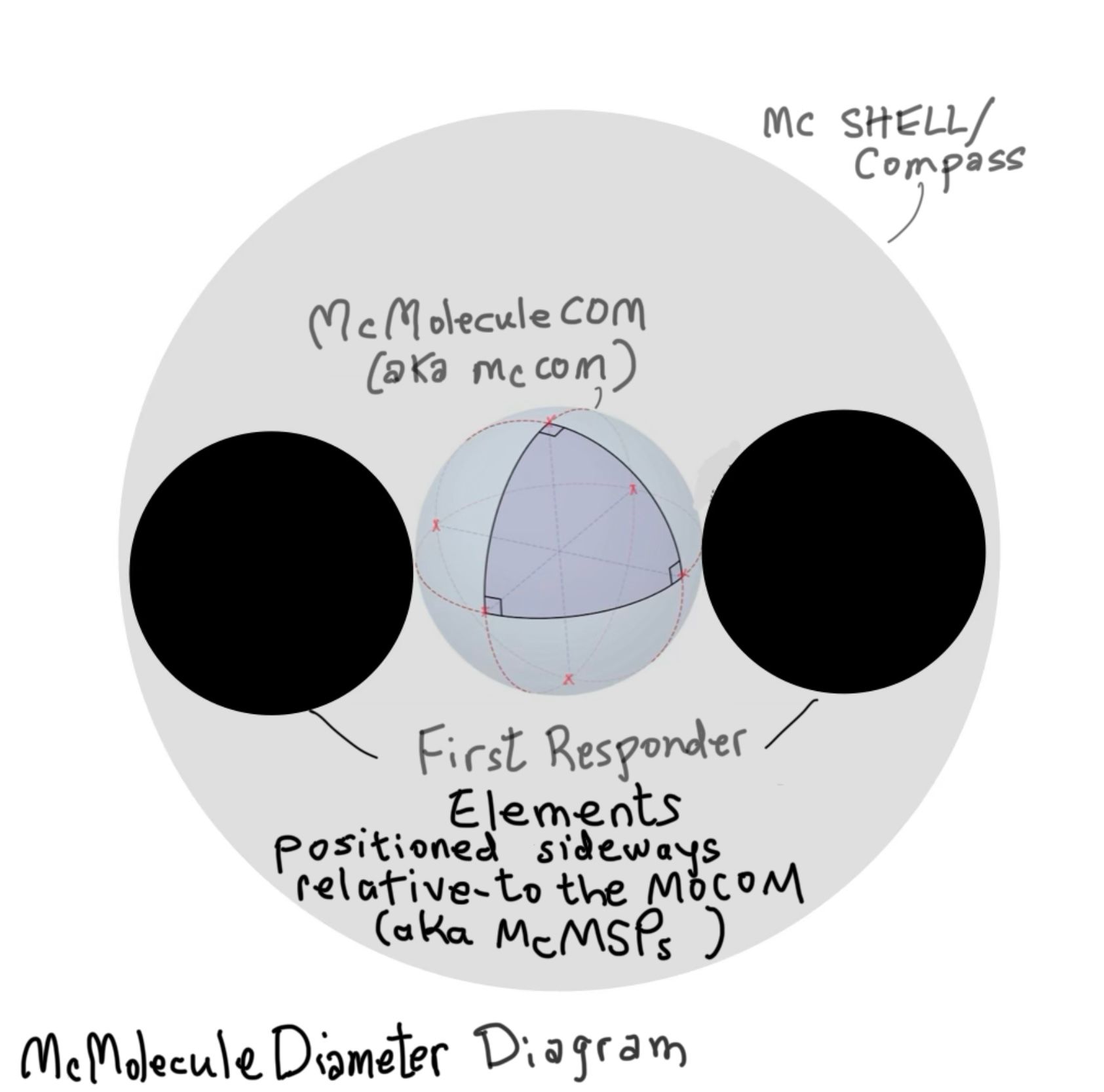
What we’re calling “First Responder Elements” are attached to the McCOM.
We don’t have enough information yet to conclude whether or not the McMolecule Diameter Diagram illustrates a real McMolecule.
But one thing we NOTICE is that if a First Responder Element is positioned in a 3-d sideways direction relative-to the McCOM, then it will also become an *internal* Moving Service Provider (“MSP”) to the McCOM (so let’s get even more specific and call the First Responder Elements positioned sideways relative-to the McCOM the “McMSPs”).
Another thing we NOTICE is that if a First Responder Element were to be positioned VERTICALLY above or below the McCOM (at 0-degrees or 180-degrees on the Mc SHELL/Compass), then it would form what we could call a VERTICAL “McBackbone” with the McCOM (a VERTICAL McBackbone is not shown in the McMolecule Diameter Diagram), so let’s call a First Responder Element that forms a McBackbone with the McCOM a “McBackbone Element”.
A third thing we NOTICE is that the Mc SHELL/Compass and each of the First Responder Element SHELL/Compasses will have an Absolute-Relative Relationship, with the Mc SHELL/Compass being on top of—and therefore DEPENDENT-ON the existence of—each Element SHELL/Compass within it.
A fourth thing we NOTICE is that it will always take the same amount of time for every McMolecule to respond to any EXTERNAL MOVING SERVICE (“MS”), because there are always TWO ELEMENTS IN THE McMOLECULE that must experience the MS: (i) a McMSP Element; and (ii) the McCOM itself.
Fifth and finally, we NOTICE that the exact amount of time it takes for a lone McMolecule to respond (e.g., to MOVE) after experiencing any MS will be TWICE THE AMOUNT OF TIME it takes for a lone Element (a lone ATM or a lone TATM) to respond to an MS, and we RECALL (see Article 9, Part IV, Q&A 5) that it takes TWO INSTANTS for a lone Element to completely respond (e.g., to MOVE) after experiencing an MS, ergo, it will take FOUR INSTANTS for a McMolecule to completely respond (e.g., to MOVE) after experiencing an MS.
The End of CONSTRAINT 1!
⛓️ CONSTRAINT 2.
(a) all of the Elements in a McMolecule must have the SAME RELATIVE MASS;
(b) this means that individual McMolecules can be represented by an Atomic Number on the Periodic Table corresponding to the NORMAL WPD of the BTPs inside of the Elements, and McMolecules represented by the same Atomic Number will emit the SAME WAVE-LENGTH LOGS in their Emack, but the QUANTITY of Wave-Length Logs in their Emack might differ based-on HOW MANY ELEMENTS the McMolecule contains;
(c) we notice that we can CALCULATE a McMolecule’s at-rest Relative McMass and a Molecule’s in-motion Relative McMass-Minus in units of WAVE-LENGTH FORCE PER McMOLECULE in the same way that we CALCULATE an Element’s Relative Mass and Relative Mass-Minus, and we also notice that a McMolecule’s Rest WPD (which we’re going to call “McRest WPD” comprising “FmackMcRest” and “EmackMcRest”) is equal to at-rest Relative McMass, and a McMolecule’s Rest-Minus WPD (which we’re going to call “McRestMinus WPD” comprising “FmackMcRestMinus” and “EmackMcRestMinus”) is equal to in-motion Relative McMass-Minus;
(d) we’re going to call a group of McMolecules represented by the SAME ATOMIC NUMBER a “McMolecule Fam,” or “McFam”;
(e) the McMolecules in every McFam must be built from the same set of McMolecule Templates (“McTemplates,” we’re going to call them), which specify fixed GEOMETRIES/SHAPES
In the context of a McBackbone Element, we already know that if a McMolecule has a McBackbone, then it must be analogous to an ATM Backbone or a TATM Backbone, which means a SEPARATE, AT-REST LEGAL ENTITY, and the only way that would be physically-possible is if the McCOM and the McBackbone Element REDUCED EACH OTHER TO REST, i.e., had the SAME RELATIVE MASS.
In the context of McMSPs, if they could have DIFFERENT RELATIVE MASS from each other or from the McCOM—i.e., be made from BTPs with different NORMAL WPDs corresponding to different Atomic Numbers—then MOTION ANALYSIS would be impossible, because we would have no way of deducing the CAUSE of McMolecule speed and direction; there would be too many variables to account-for and no way to solve-for some of those variables.
But THAT’S NOT HOW VALID/FAIR LAWS WORK; that’s how CORRUPTION/UNFAIRNESS works, and we must assume that God (who is FAIR) created the universe for FAIR Self-conscious beings to inhabit in perpetuity.
Of course, EVENTUALLY, combining matters represented by different Atomic Numbers in the Periodic Table to create different types of MATERIALS (i.e., OBJECTS with different “chemical” properties than any of the matters represented by the same Atomic Number) is going to be NECESSARY, but at this juncture, we know (see CONSTRAINT 1) that McMolecules must be UNALTERABLE OBJECTS made from Elements, so therefore WE MUST CONCLUDE that it’s physically-impossible to combine Elements with different RELATIVE MASS in the same McMolecule to create different types of MATERIALS.
Another way to think about the issue of COMPLEXITY is that It’s a Legal Truism that where there’s Legal Necessity, there’s also Legal Sufficiency, ergo, THE MINIMUM LEVEL OF COMPLEXITY IN A McMOLECULE MUST BE SUFFICIENT.
But that answer might sound INSUFFICIENT lol, so let’s think about McMSPs some more: common sense alone tells us that the McCOM could not have a SMALLER RELATIVE MASS than the McMSPs, simply because the McCOM is the “anchor” of the McMolecule, and it is nonsensical for an anchor Element to be less massive than an anchored Element.
There is also a common-sense reason why the McCOM could not have a LARGER RELATIVE MASS than the McMSPs, to wit: in that case, it would POSSIBLE for the RELATIVE MASS of the McCOM to be LARGER than the COMBINED RELATIVE MASS OF THE TOTAL NUMBER OF McMSPs APPLYING UNBALANCED FORCE TO THE McCOM; and in that case, the LONE McMolecule would remain stationary, but NOT because the McCOM was experiencing BALANCED FORCE, and we would have no way of deducing the Relative McMass or the geometric shape of the lone McMolecule as a result of that situation.
So we see that for the purposes of MOTION ANALYSIS, the Relative McMass and the Relative McMass-Minus of any given McMolecule can be CALCULATED SIMPLY, as follows:
at-rest Relative McMass in units of WAVE-LENGTH FORCE PER McMOLECULE = Relative Mass of each Element *MULTIPLIED BY* Total Number of Elements in the McMolecule;
and
in-motion Relative McMass-Minus in units of WAVE-LENGTH FORCE PER McMOLECULE = Relative Mass of each Element *MULTIPLIED BY* (Total Number of Elements in the McMolecule *MINUS* N), where N = the number of “WINNING McMSPs” in the McMolecule, with a WINNING McMSP causing the McCOM at the center of the McMolecule to experience UNBALANCED NET FORCE (let’s refer-to a McCOM’s NET FORCE experience as “SETFMc”, comprising “MAGNITUDE SETFMc” and “DIRECTION SETFMc”), i.e., MAGNITUDE SETFMc > 0, and therefore a WINNING McMSP is “carrying its own weight”.
Now we RECALL that an Element’s at-rest Relative Mass is SYNONYMOUS with the Element’s “inertial” REST WPD (comprising equal-magnitude, opposite-direction FmackRest and EmackRest).
See the following excerpt from Article 9, PART IV B, Topic 12, Q&A 9:
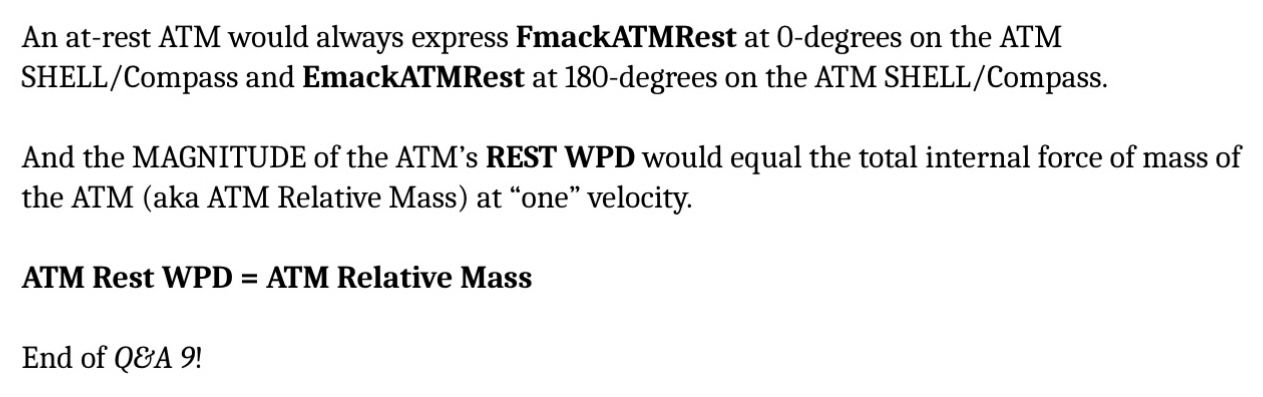
Ergo, a McMolecule’s at-rest Relative McMass = the McMolecule’s “inertial” Rest WPD (let’s refer-to a McMolecule’s Rest WPD as “McRest WPD,” comprising “FmackMcRest” and “EmackMcRest”).
Now we ALSO RECALL that an Element’s in-motion Relative Mass-Minus is SYNONYMOUS with the Element’s “inertial” REST-MINUS WPD (comprising FmackRestMinus and EmackRestMinus).
See the following excerpt from Article 9, PART IV B, Topic 12, Q&A 10:
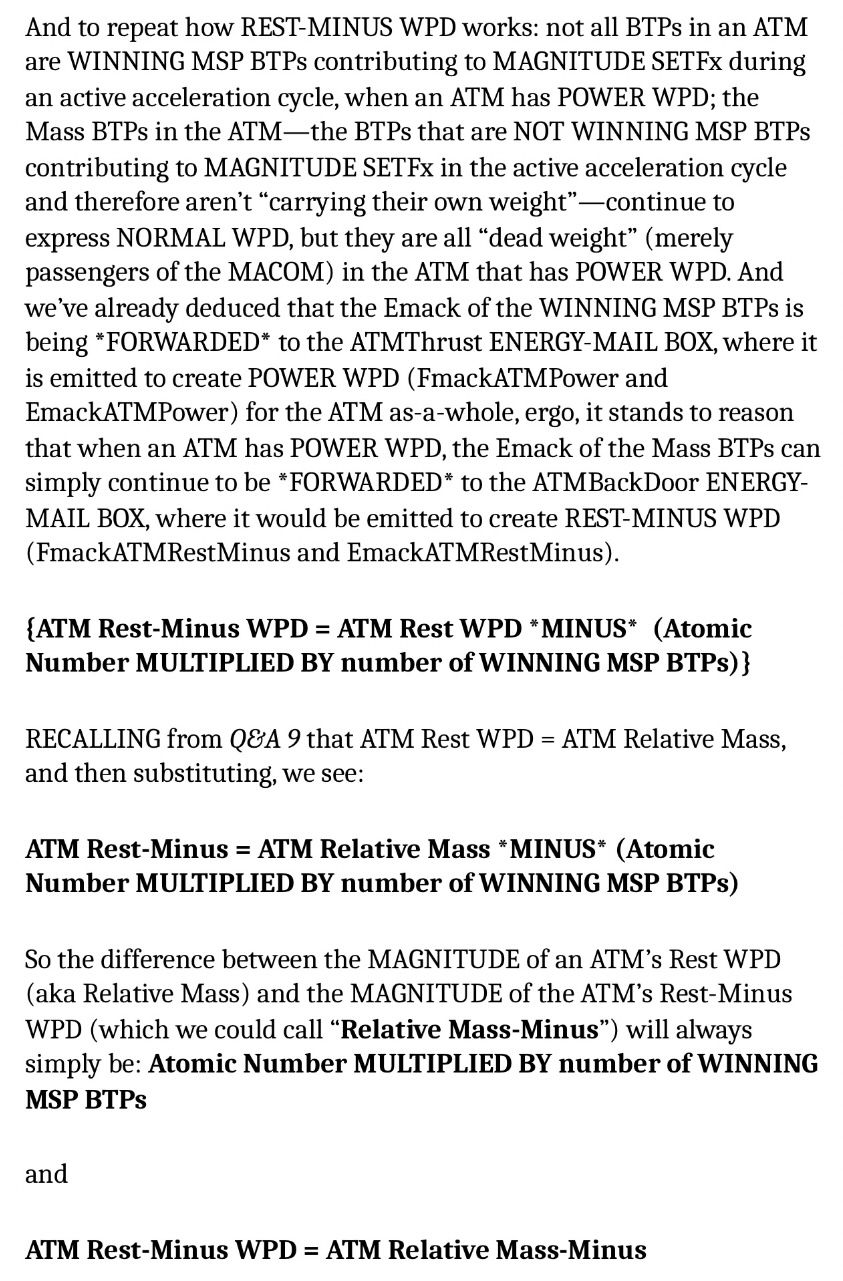
Ergo, a McMolecule’s in-motion Relative McMass-Minus = the Molecule’s “inertial” Rest-Minus WPD (let’s refer-to a McMolecule’s Rest-Minus WPD as “McRest-Minus WPD,” comprising “FmackMcRestMinus” and “EmackMcRestMinus”).
And of course the WAVE-LENGTH LOGS that a McMolecule emits in its Emack—the McMolecule’s “McSpectra,” let’s say—will be the same as the Wave-Length Logs in the Atomic Spectra emitted by the Elements from which the McMolecule is built.
This means that a McSpectra will correspond to a specific Atomic Number.
This also means that among McMolecules with the same McSpectra, only the QUANTITY of emitted Wave-Length Logs might be different, based-on how many Elements are in the McMolecule.
So let’s call a group of McMolecules made from Elements represented by the same Atomic Number in the Periodic Table a “McMolecule Fam,” or “McFam”.
We NOTICE that McMolecules in different McFams might have ONLY SOME—OR MIGHT HAVE NONE—OF THE SAME WAVE-LENGTH LOGS in their Emack.
So let’s begin to refer-to McMolecule Templates (“McTemplates,” let’s call them)—meaning the “blueprints” for McMolecules in the same McFam—that enable a set of McMolecules to be populated with Elements having the SAME RELATIVE MASS, but with different McMolecules in the same McFam having DIFFERENT GEOMETRIES/SHAPES, and possibly having A DIFFERENT QUANTITY OF ELEMENTS, i.e., a different at-rest Relative McMass and in-motion Relative McMass-Minus.
But REMEMBER that although the GEOMETRY/SHAPE and Relative McMass (and Relative McMass-Minus) of McMolecules in the same McFam may differ, we can be certain that McMolecules in the same McFam will exhibit the same “material” properties, because they will have the SAME WAVE-LENGTH LOGS in their emitted Emack.
The End of CONSTRAINT 2!
⛓️ CONSTRAINT 3. McMSP Elements must be the McCOM’s type (ATMs if the McCOM is an ATM, and TATMs if the McCOM is a TATM), and there must be two Nuclear Types per McFam, which means that each McFam must be divided into two Nuclear Fams:
(1) the “NuclearFamATM,” we’re going to call it, in which the McTemplates all have an ATM McCOM (we are going to call those finished McMolecules “McATMs”);
and
(2) the “NuclearFamTATM,” we’re going to call it, in which the McTemplates all have a TATM McCOM (we are going to call those finished McMolecules “McTATMs”)
The reason why McMSPs would have to be the McCOM’s type (either ATM type or TATM type) is because (as discussed in CONSTRAINT 2) a McMolecule’s McRest WPD must be the sum of the at-rest Relative Masses, aka the “inertial” Rest WPDs, of the Elements in the McMolecule, but THE PROBLEM IS that ATMs and TATMs express the two components of their “inertial” Rest WPD in OPPOSITE VERTICAL DIRECTIONS on the Element SHELL/Compass.
To repeat: ATMs and TATMs express “inertial” Rest WPD—and therefore “inertial” Rest-Minus WPD as well—in opposite directions from each other.
Ergo, TO AVOID UNNECESSARY “INTERNAL” CONTRADICTIONS, it’s NECESSARY for INTERNAL MOVING SERVICE PROVIDER ELEMENTS—McMSPs—and the McCOM to express “inertial” WPD in the same directions.
And we know that it’s always going to be physically-possible for McMSPs to be the same type (either ATM type or TATM type) as the McCOM, because all Elements have a BTP behind the door at every 3-d SIDEWAYS DIRECTION/DEGREE on the Element SHELL/Compass, and by definition, McMSPs are attached to the McCOM at 3-d SIDEWAYS DIRECTIONS/DEGREES on the Mc SHELL/Compass, so therefore it will always be physically-possible for a McMSP to provide a Moving Service (MS) to the McCOM and vice-versa at every 3-d SIDEWAYS DIRECTION/DEGREE on the Mc SHELL/Compass.
So we can confidently conclude that the McCOM’S TYPE—ATM or TATM—is the same as the McMSP TYPE.
The McBackbone Element, however, presents a different situation, because the McBackbone Element is analogous to BTP1 in an ATM or a TATM (see Article 9, PART IV A, Topic 12, Q&A 4), and as such, the McBackbone Element is NEVER going to be a Moving Service Provider (MSP) to the McCOM, so therefore it’s unnecessary for the McBackbone Element to be the same type (ATM or TATM) as the McCOM. And that’s fortuitous, because as we know (and will discuss directly below regarding COLLISIONS), it’s physically-impossible for two ATMs or two TATMs to COLLIDE VERTICALLY along the same 3DADL and BOTH PROVIDE A MOVING SERVICE (MS) TO EACH OTHER.
But still, we have to QUESTION whether it is NECESSARY for one McFam to include McMolecules with ATM McCOMs *and* McMolecules with TATM McCOMs, or whether McMolecules with one type of McCOM would suffice?
The ANSWER depends-on whether or not there are necessary types of INTERACTIONS BETWEEN McMOLECULES that can only be achieved between McMolecules having different types of McCOMS.
So let’s think about COLLISIONS between McMolecules.
When one McMolecule tries to become a Moving Service Provider (MSP) applying an external MS to another McMolecule in a 3-d sideways direction/degree on the other Mc SHELL/Compass, then—assuming that the Moving Service Recipient (MSR) McMolecule has an ATM or TATM directly behind the door at that specific 3-d direction/degree on the Mc SHELL/Compass—THE McCOM TYPE OF BOTH THE MSP AND THE MSR IS IRRELEVANT.
The only situation we have to worry about is when a wanna-be MSP or MSR does NOT have an Element (an ATM or a TATM) directly behind the door—the 3-d direction/degree on the Mc SHELL/Compass—at which a collision occurs.
For example, RECALL (see Article 9, PART IV B, Topic 12, Q&A 11) that it’s physically-possible for two ATMs to become “stuck together” and vertically-immovable even upon the application of another external vertical force—creating a “roadblock” on a 3DADL as a result—if the ATMs collide along the same 3DADL and either ATM is trying to be a MSP to the other.
ALSO RECALL that this situation—two ATMs becoming “stuck together” and vertically-immovable, thereby creating a “roadblock” on a 3DADL—is THE ONLY WAY THAT TWO ATMs CAN COLLIDE AND REMAIN STATIONARY ON A 3DADL.
Likewise (see Article 9, PART IV B, Topic 12, Q&A 12), two TATMs becoming “stuck together” and vertically-immovable, thereby creating a “roadblock” on a 3DADL, is THE ONLY WAY THAT TWO TATMs CAN COLLIDE AND REMAIN STATIONARY ON A 3DADL.
So NOW WE SEE THE PROBLEM this is going to cause in the McMolecule context, to wit: regardless of their Relative McMass, two McMolecules that both have ATM McCOMs (which cannot, by definition, have McBackbone Elements attached to the McCOM at 180-degrees on the Mc SHELL/Compass, because there is no BTP behind the door at 180-degrees on the ATM SHELL/Compass) OR two McMolecules that both have TATM McCOMs (which cannot, by definition, have McBackbone Elements attached to the McCOM at 0-degrees on the Mc SHELL/Compass, because there is no BTP behind the door at 0-degrees on the TATM SHELL/Compass) will SUFFER FROM THE SAME INABILITY to “bond vertically” with each other via COLLISION yet REMAIN VERTICALLY MOVABLE by external Moving Services WHILE THEY ARE “STUCK TOGETHER.”
Two McMolecules with the same type of McCOM would always create a “roadblock” on a 3DADL after a collision!
The only way to SOLVE THE VERTICAL ROADBLOCK PROBLEM is to create duplicate sets of McMolecule Templates with different Nuclear Types in each McFam, which means that each McFam must be divided into two “Nuclear Fams”:
(1) the “NuclearFamATM,” let’s call it, with an ATM McCOM at the center of each McMolecule (let’s call those finished McMolecules “McATMs”);
and
(2) the “NuclearFamTATM,” let’s call it, with a TATM McCOM at the center of each McMolecule (let’s call those finished McMolecules “McTATMs”).
The End of CONSTRAINT 3!
⛓️ CONSTRAINT 4. NO KISSING is allowed between any First Responder Elements attached to the McCOM
To ensure the INTEGRITY of FORCE TRANSMISSIONS, each First Responder Element in a McMolecule must be KISSING THE McCOM ONLY; no kissing between First Responder Elements attached to the same McCOM can occur, because otherwise we would be CREATING AN INTERNAL “N-BODY KISSING PROBLEM,” which is analogous to the essentially UNSOLVABLE “N-BODY PROBLEM” https://en.wikipedia.org/wiki/N-body_problem that is encountered when three or more objects are ostensibly applying gravitational force to each other.
Fortunately, the “kissing number problem” has already been solved, because if it hadn’t been solved, then I surely would NEVER have been able to figure out the answer for myself with my less-than-remedial math skills.
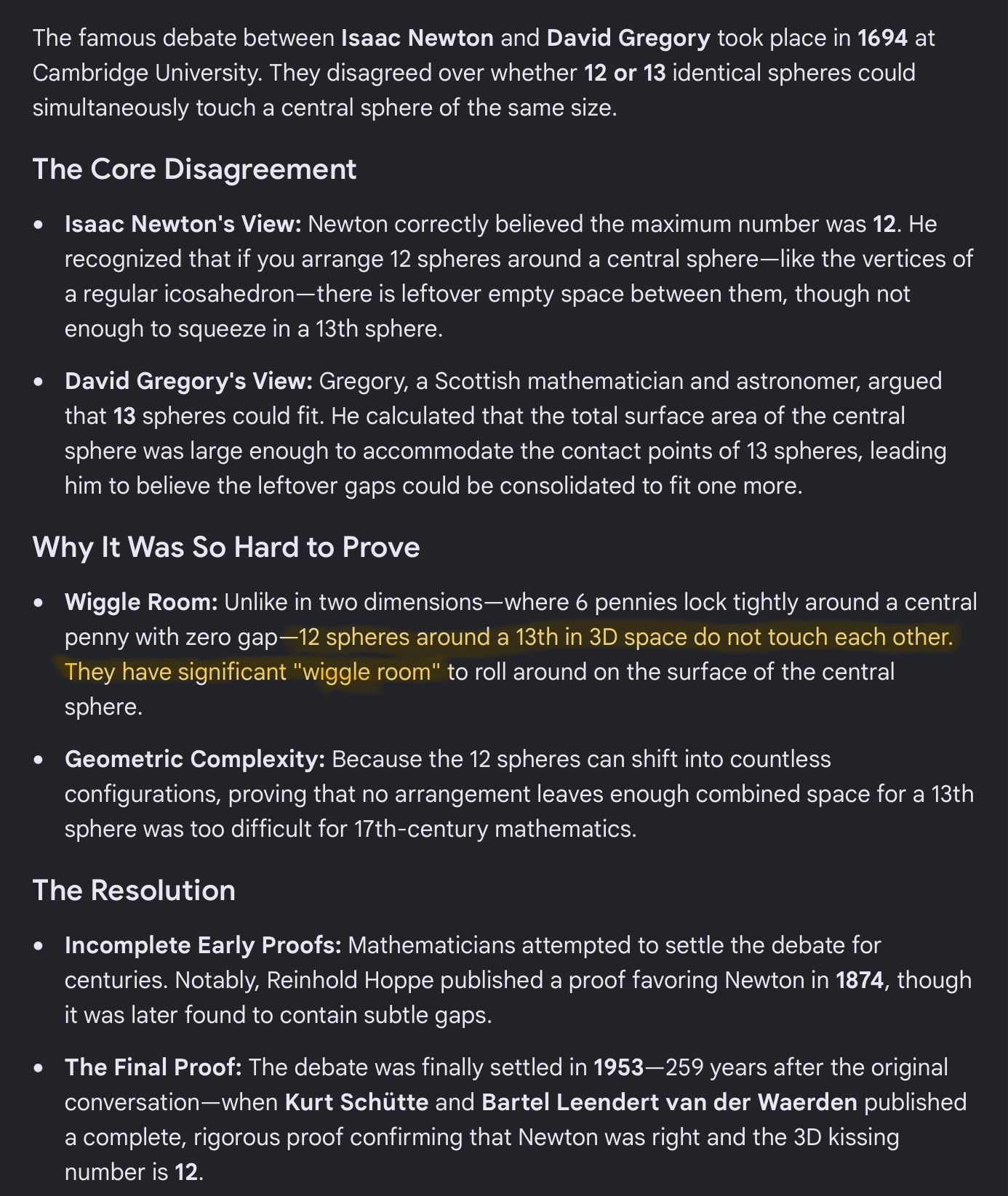
So to repeat what we know: we know that *WITHOUT KISSING*, EXACTLY 12 SPHERES OF THE SAME DIAMETER CAN FIT around and touch a central sphere having the same diameter as the surrounding spheres.
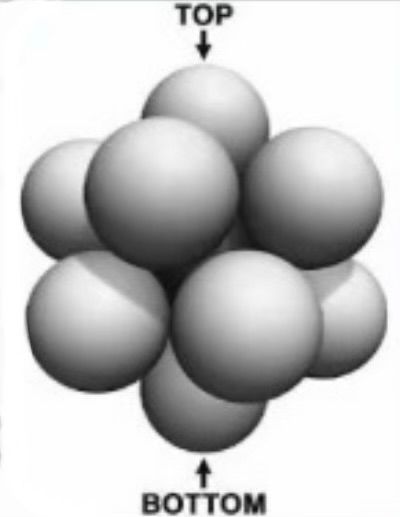
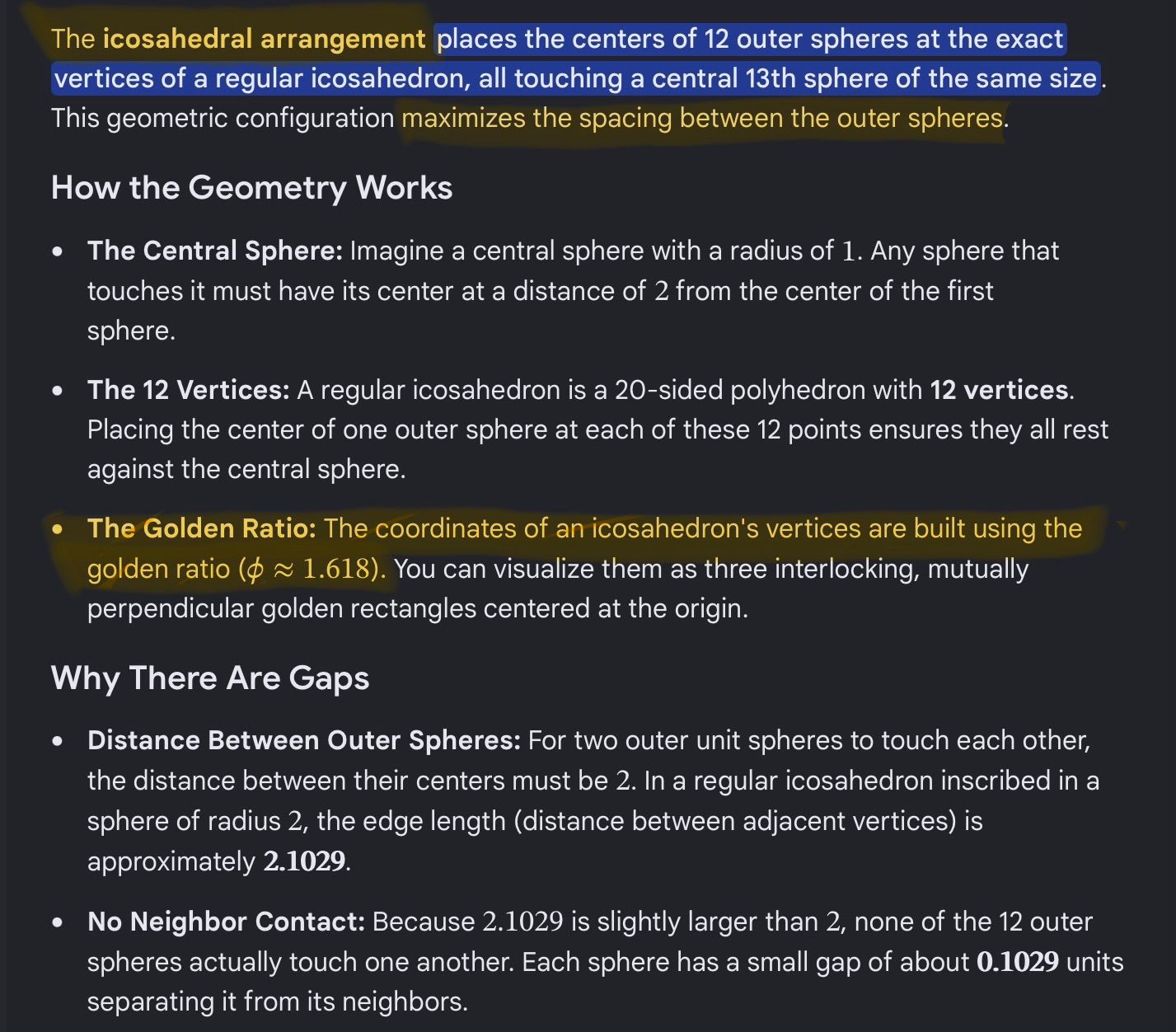

Now let’s PRETEND that we’re implementing the solution to the “kissing number problem” with a McMolecule having a spherical Mc SHELL/Compass with a 3-Element diameter surrounding 12 First Responder Elements (10 McMSPs and two McBackbone Elements) arranged WITHOUT KISSING around a central McCOM in TWO DIFFERENT CROSS-SECTIONAL “HORIZONTAL CIRCLES” (a “Top Circle of McCOM SHELL” and a “Bottom Circle of McCOM SHELL”) SLICED PERPENDICULAR TO A 3DADL (aka a VERTICAL AXIS), with the McMSPs in a given Circle of McCOM SHELL having an attachment point to the McCOM at a certain “BOND ANGLE” corresponding to a direction/degree on the McCOM SHELL/Compass and the Mc SHELL/Compass.
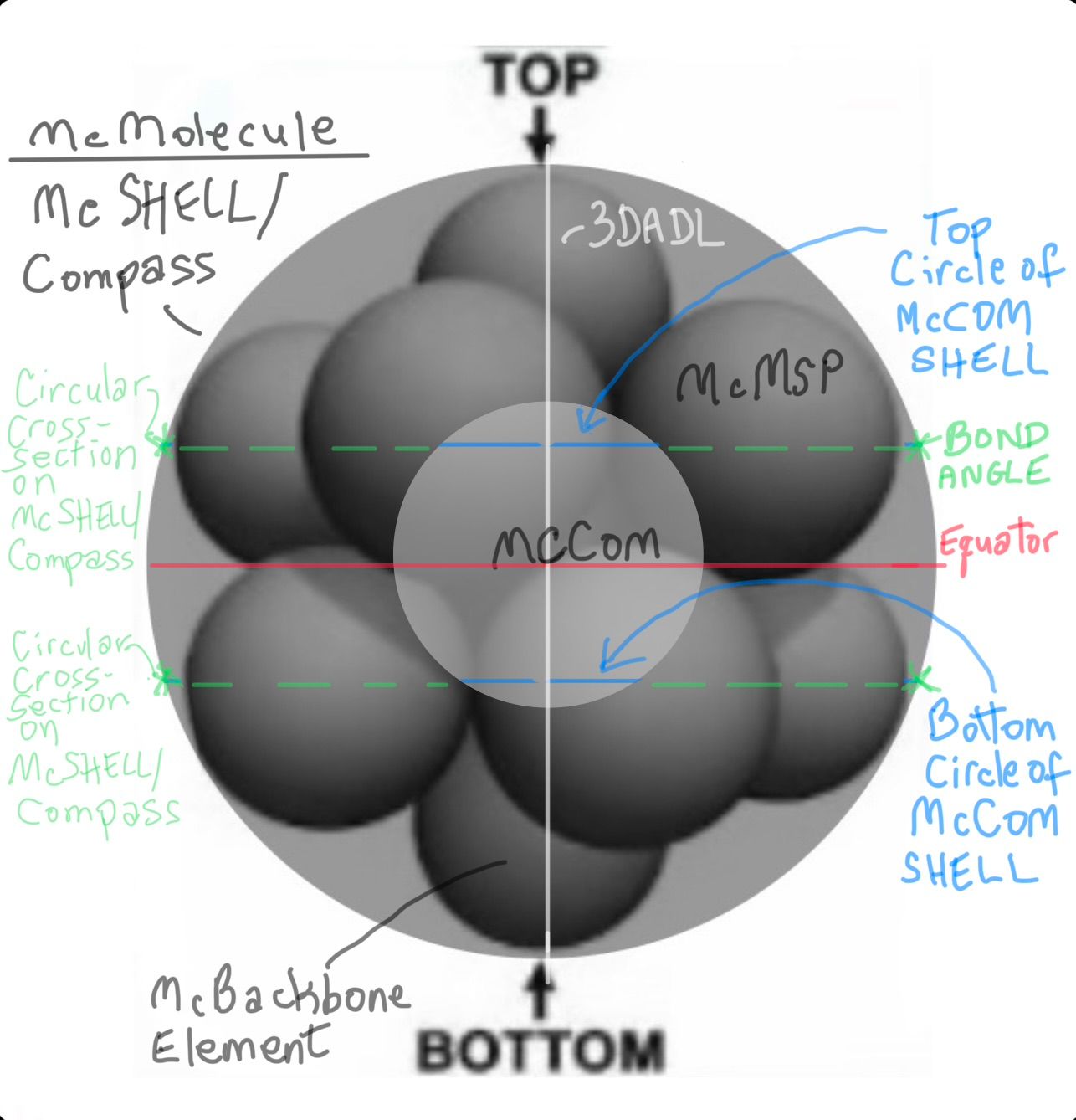
WE DON’T KNOW IF THIS COULD BE A REAL McMOLECULE; that’s a question we have to answer. But we’ve got to start with this maximal geometry now, then as we add CONSTRAINTS, we can make adjustments if necessary.
NOTE that IN GENERAL—meaning ALWAYS/INHERENTLY—the BOND ANGLE corresponding to a direction/degree on the McCOM SHELL/Compass and the BOND ANGLE corresponding to a direction/degree on the Mc SHELL Compass will be THE SAME DIRECTION/DEGREE, because the McCOM is at the center of the Mc SHELL Compass.
ALSO NOTE that SPECIFICALLY IN THIS CASE—meaning that a McMolecule would have to be INTENTIONALLY DESIGNED this way—the BOND ANGLES of all the McMSPS will be the same, and that’s because the McMSPs are arranged EQUAL DISTANCE APART in each Circle of McCOM SHELL.
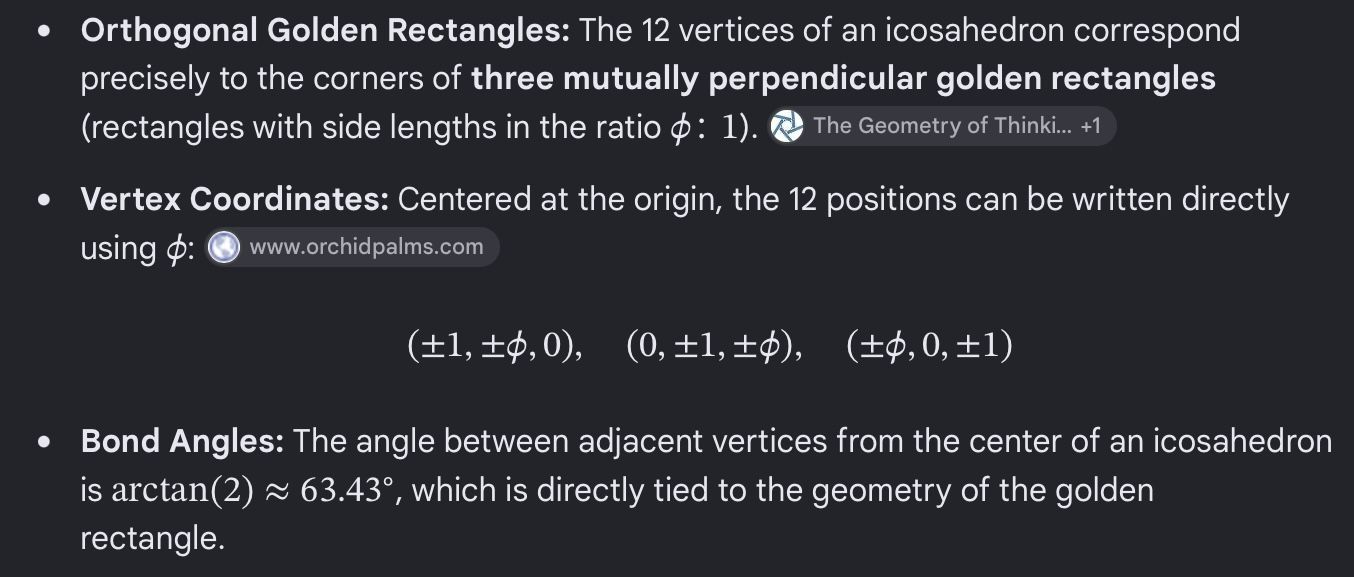
To better envision the internal proportions of this IMAGINARY MAXIMAL McMOLECULE, let’s enlist the help of still-shots that I took from the video entitled “Euclid’s Construct of an Icosahedron”: https://youtu.be/biq_SXjaoRU?is=9xXE-VQjwdISea07, including some mark-ups that I made by hand to illustrate aspects of the McMolecule construct.
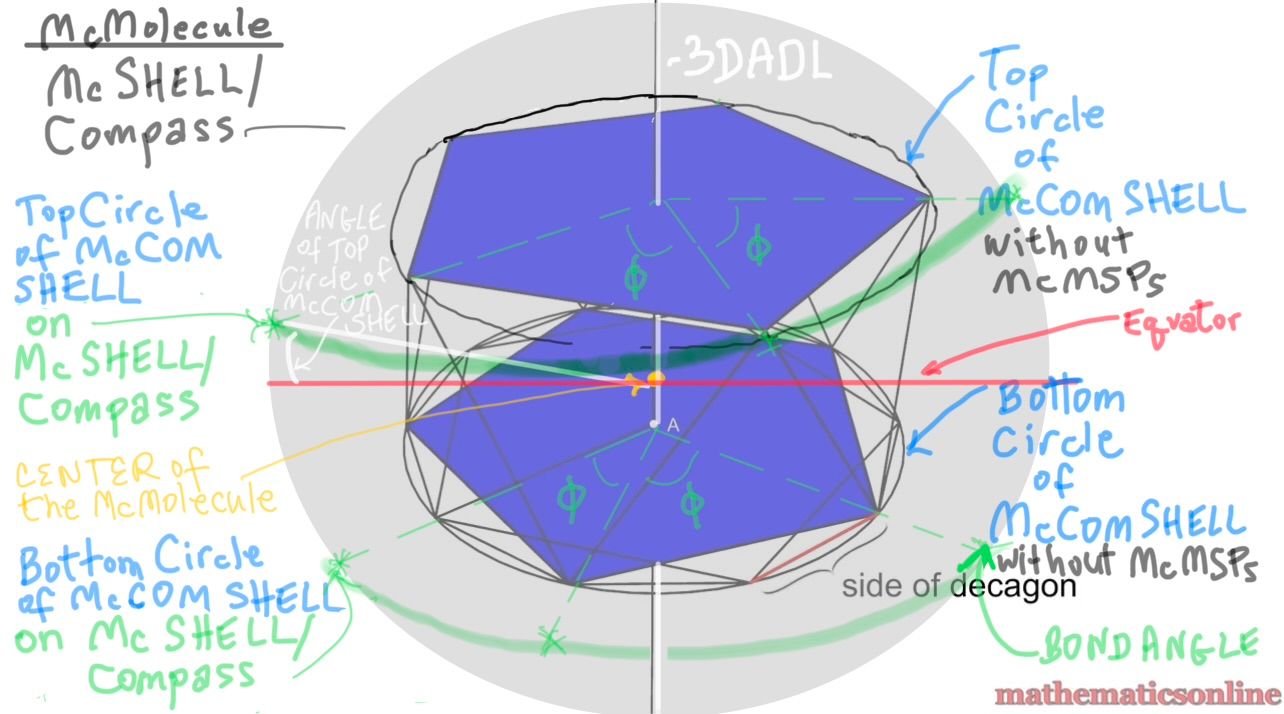
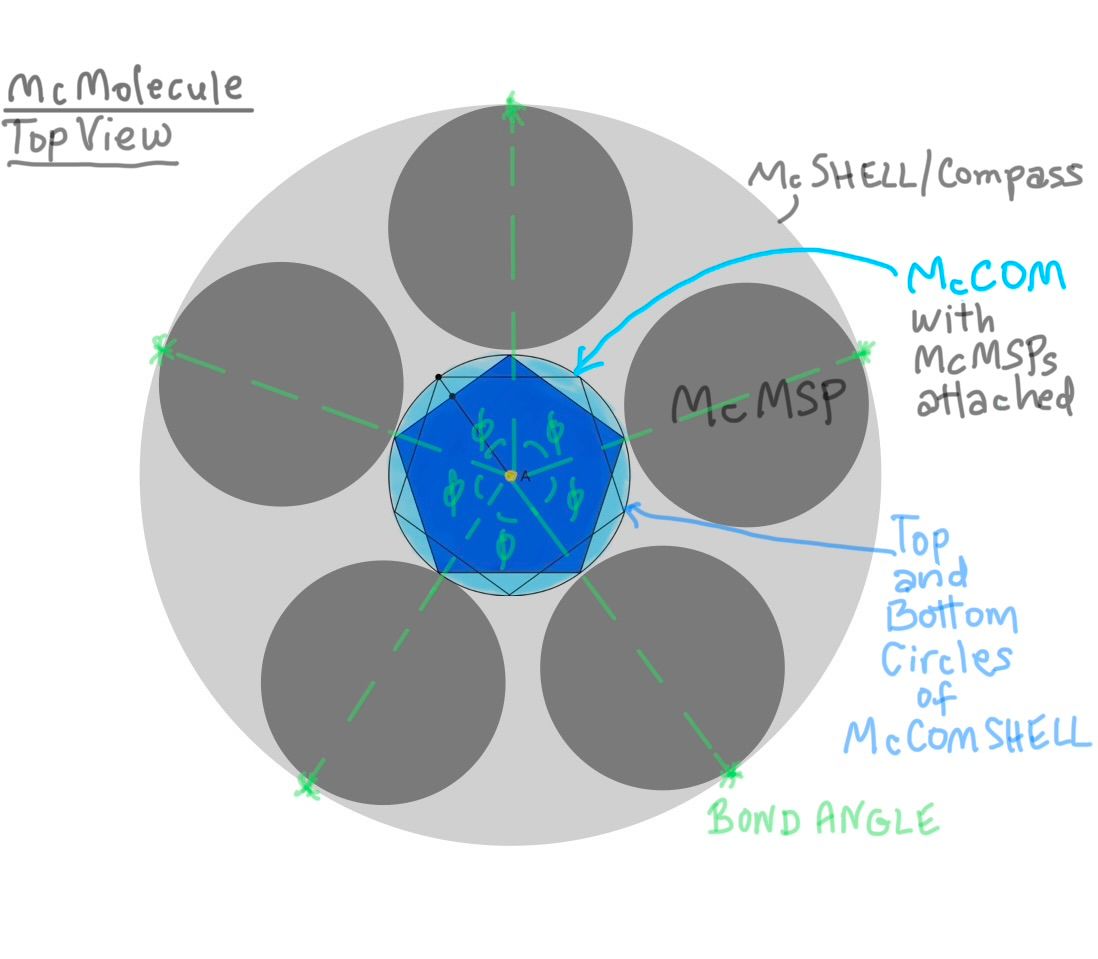
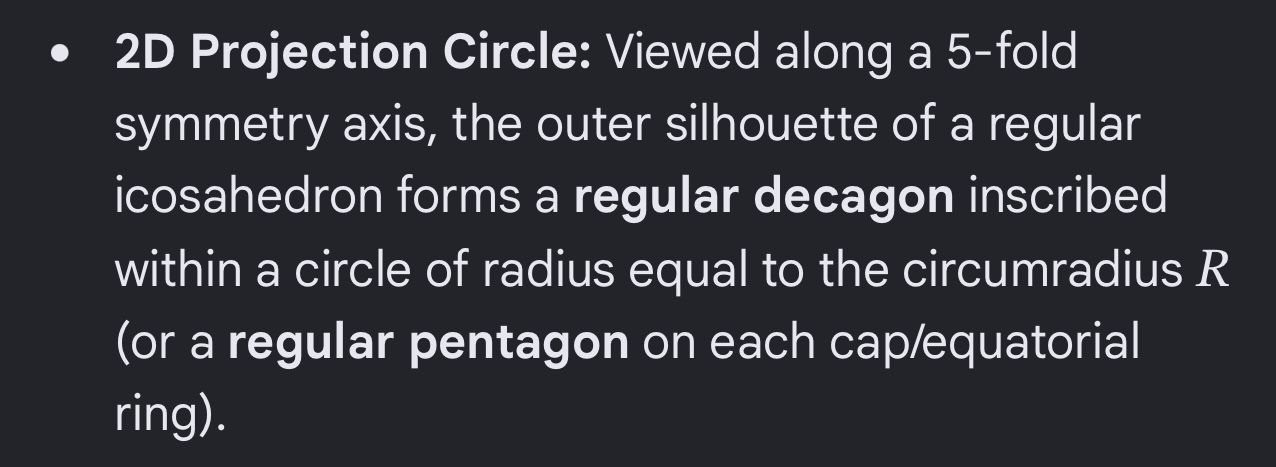
Now let’s DESCRIBE WHAT WE SEE in the diagrams in TERMS THAT ARE RELEVANT TO McMOLECULE CONSTRUCTION.
The first thing we AGAIN NOTICE—other than the single TOP and BOTTOM McBackbone Elements lying along the same VERTICAL LINE, which we would call a 3DADL or a VERTICAL AXIS—is the TWO DIFFERENT CROSS-SECTIONAL “HORIZONTAL CIRCLES” OF McMSPs, i.e., McMSPs having attachment points to the McCOM that lie in the same HORIZONTAL CIRCULAR CROSS-SECTION of the spherical Mc SHELL/Compass.
And to repeat what we have already said: the McMSPs are arranged around the McCOM in TWO “Circles of McCOM SHELL” (labeled the “Top Circle of McCOM SHELL” and the “Bottom Circle of McCOM SHELL”) in opposite halves of the McMolecule, with each Circle of McCOM SHELL defining a cross-section of the McMolecule sliced PERPENDICULAR TO THE VERTICAL AXIS.
Now upon closer inspection of the diagrams, we can see FIVE McMSPs EQUAL DISTANCE APART (with the same BOND ANGLE, φ, between them) in the Top Circle of McCOM SHELL, and we can see FIVE McMSPs EQUAL DISTANCE APART (with the same BOND ANGLE, φ, between them) in the Bottom Circle of McCOM SHELL.
And we NOW NOTICE that the Top Circle of McCOM SHELL and the Bottom Circle of McCOM SHELL each have a CENTER that is a certain DISTANCE away from the CENTER OF THE McMOLECULE (which would also be the center of the McCOM), and they each have an ANGLE RELATIVE-TO THE VERTICAL AXIS that can be determined as follows: first, envision a line between the CENTER OF THE McMOLECULE and a point on the SURFACE OF THE McMOLECULE, i.e., a direction/degree on the Mc SHELL/Compass, corresponding to a direction/degree on the McCOM SHELL/Compass within the Circle of McCOM SHELL (and REMEMBER that each McMSP has an attachment point to the McCOM at a certain BOND ANGLE within the Circle of McCOM SHELL, and since the McCOM is at the center of the McMolecule, the BOND ANGLE will be at the same direction/degree on the Mc SHELL/Compass as it is on the McCOM SHELL/Compass); then second, find the angle between the envisioned line and the VERTICAL AXIS.
We ALSO NOTICE that the Top Circle of McCOM SHELL and the Bottom of Circle of McCOM SHELL are THE SAME DISTANCE APART as the McMSPs in those two Circles of McCOM SHELL, which informs us that the ANGLE of the Top Circle of McCOM SHELL relative-to the VERTICAL AXIS and the ANGLE of the Bottom Circle of McCOM SHELL relative-to the VERTICAL AXIS are BOTH EQUAL to the BOND ANGLE, φ, between McMSPs.
QUESTION: Might there be a “Middle Circle of McCOM SHELL” located along the equator line (90-degrees/270-degrees) on the McCOM SHELL Compass at a 90-DEGREE ANGLE RELATIVE TO THE VERTICAL AXIS of the Mc SHELL/Compass, and sharing the SAME CENTER AS THE McMOLECULE?
ANSWER: Yes, there is a Circle of McCOM SHELL at EVERY 3-d SIDEWAYS DIRECTION/DEGREE ON THE McCOM SHELL/Compass and the McSHELL/Compass! But if Elements were attached to the McCOM in the Middle Circle of McCOM SHELL, then fewer than 12 Elements would fit around the McCOM, so that’s why we don’t see a Middle of Circle of McCOM SHELL in the solution to the “kissing number problem.”
Also, we NOTICE that even if we tried, we couldn’t fit more than FIVE Elements in the Middle Circle of McCOM SHELL, because SIX SPHERES OF THE SAME DIAMETER ARRANGED AROUND A CENTRAL SPHERE OF THE SAME DIAMETER WILL ALWAYS TOUCH EACH OTHER, causing a KISSING VIOLATION.
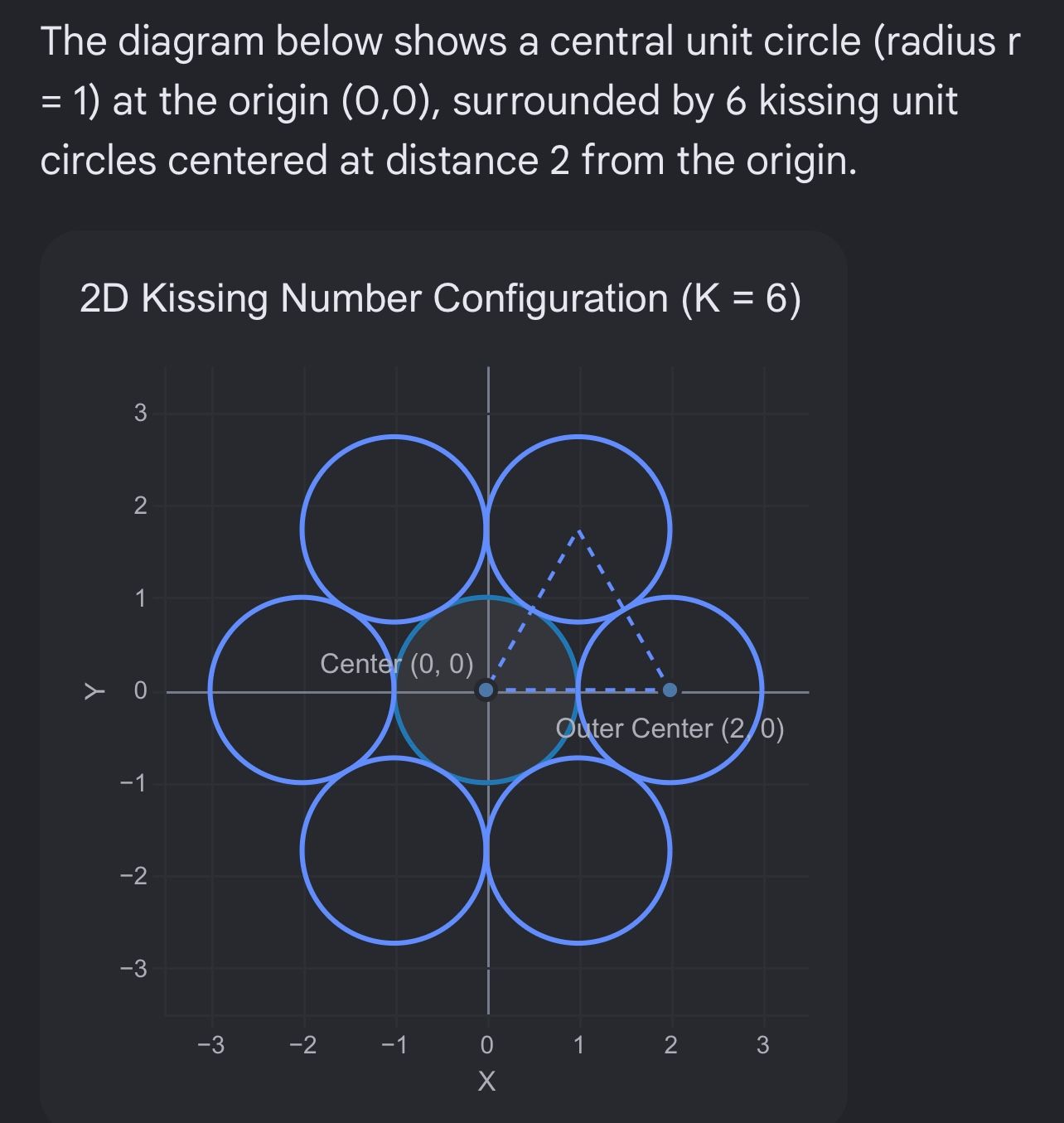
To summarize the RELEVANCE of the solution to the “kissing number problem” in the McMolecule context as we understand it SO FAR: regardless of the Circles of McCOM SHELL occupied by McMSPs in a McMolecule, we NOTICE that the KISSING PROHIBITION is going to cause a McMolecule’s inner structure to be a lot sparser than the inner structure of an Element, in which 128,881 BTPs will fit around the MACOM BTP without kissing (see Article 9, Part IV A, Topic 12, Q&A 1)!
This is because a BTP is defined by its 423DCTCC, which is actually linear, not spherical, so therefore one BTP can be attached to the MACOM at every 3-d degree of an Element SHELL/Compass *except* at 180-degrees on the ATM SHELL/Compass and at 0-degrees on the TATM SHELL/Compass, where the MACOM itself is positioned.
The End of CONSTRAINT 4!
⛓️ CONSTRAINT 5. A McMolecule must be capable of experiencing BALANCED ROTATION around either the VERTICAL AXIS (i.e., a 3DADL) or the HORIZONTAL AXIS (i.e., the equator line on the Mc SHELL/Compass), so we’re going to call a McMolecule that experiences balanced rotation around the VERTICAL AXIS a “VERTICAL McMOLECULE,” and we’re going to call a McMolecule that experiences balanced rotation around the HORIZONTAL AXIS a “HORIZONTAL McMOLECULE”
It would be nonsensical—the opposite of “intelligent design”—to create a McMolecule having an UNBALANCED STRUCTURE, and a BALANCED STRUCTURE would be capable of experiencing BALANCED ROTATION around a STRUCTURE-DEFINING AXIS.
We know that ALL AXES OF EVERY McMOLECULE ARE RELATIVE-TO THE VERTICAL AXIS OF THE McMOLECULE, which always lies along a 3DADL; this is because the vertical axis is defined by the 3-d ABSOLUTE DIRECTIONS (3-d Down and 3-Up, with 3-d Up being RELATIVE-TO 3-d Down, and all 3-d sideways directions being RELATIVE-TO 3-d Up; see Article 3 for a detailed discussion of THE HIERARCHY OF RELATIVITY OF DIRECTIONS.)
So therefore a VERTICAL AXIS is a STRUCTURE-DEFINING AXIS of every McMolecule.
But that’s not the only STRUCTURE-DEFINING AXIS every McMolecule has, because a McMolecule must be SPHERICAL with a FIXED DIAMETER (see CONSTRAINT 1), and we know that A SPHERE is a 3-d CONSTRUCT defined by finding the intersection of the central perpendicular axes of TWO CIRCLES, which could be envisioned as WHEELS.
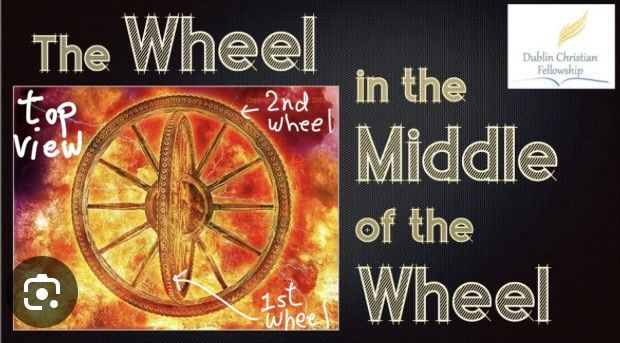
First, picture this: TWO WHEELS of the same diameter that INTERSECT ORTHOGONALLY—perpendicular to each other—and have a shared center point, with THE FIRST WHEEL ORIENTED VERTICALLY and THE SECOND WHEEL ORIENTED HORIZONTALLY relative-to the first wheel.
Second, picture this: THOSE TWO ORTHOGONALLY-INTERSECTING WHEELS defining a 3-d shape—A SPHERE—with every point on its surface being the exact same distance from the shared center point.
***PAUSE FOR MINI-Q&A***
MINI-Q: How can we PROVE that it is correct to conclude that the orthogonally-intersecting wheels described in Chapter 1 of The Book of Ezekiel were INTENDED TO CREATE A SPHERE?
MINI-A: It is because of the UNDENIABLE SPHERICAL RELEVANCE of ONE WHEEL BEING *INSIDE* OF THE OTHER WHEEL!
Specifically, it is because the VERTICAL AXIS of a SPHERE and the HORIZONTAL AXIS of the SPHERE have an ABSOLUTE-RELATIVE RELATIONSHIP (RECALL from Article 3 that the ABSOLUTE-RELATIVE RELATIONSHIP is a key concept that physics has always been missing), which means that the HORIZONTAL AXIS is “riding on top of”—and therefore dependent-on—the VERTICAL AXIS, but not vice-versa, i.e., the VERTICAL AXIS exists INDEPENDENT of the HORIZONTAL AXIS.
So therefore if we put THE FIRST WHEEL (defining the VERTICAL AXIS of the sphere) *INSIDE* of THE SECOND WHEEL (defining the HORIZONTAL AXIS of the sphere), then that will make THE VERTICAL AXIS ENTIRELY “UNDERNEATH” THE HORIZONTAL AXIS, and it will make THE HORIZONTAL AXIS ENTIRELY “ON TOP OF” THE VERTICAL AXIS, which will establish the *necessary* ABSOLUTE-RELATIVE RELATIONSHIP between the VERTICAL AXIS and the HORIZONTAL AXIS, respectively.
To repeat: The VERTICAL AXIS of a sphere defines the two ABSOLUTE 3-d DIRECTIONS of 3-d Down and 3-d Up (with 3-d Up being RELATIVE-TO 3-d Down), and we MUST define the VERTICAL AXIS in every “Circle of the SPHERE/Compass,” so to speak, by the 3-d Up direction at 0-degrees and the 3-d Down direction at 180-degrees (a “Circle of a SPHERE/Compass” can be defined as a cross-section of a given SPHERE/Compass having radius R, sliced PERPENDICULAR TO THE VERTICAL OR HORIZONTAL AXIS, with each Circle of the SPHERE/Compass having a CENTER that is a certain DISTANCE—between zero and R—away from the center of the SPHERE/Compass, so that the “Middle Circle of the SPHERE/Compass” would share the same center point as the sphere itself, being zero distance away from the center point), so then the SIDEWAYS directions of the HORIZONTAL AXIS (the directions of the HORIZONTAL AXIS are opposite 3-d SIDEWAYS DIRECTIONS at 90-degrees and 270-degrees in the Middle Circle of the SPHERE/Compass) will always be RELATIVE-TO both directions (3-d Down AND 3-d Up) on the VERTICAL AXIS.
***END OF PAUSE FOR MINI-Q&A***
Now NOTICE that the VERTICAL AXIS of the SPHERE can be envisioned as a vertical line through the center point, so that it’s like the second wheel is dividing the VERTICAL AXIS—and the McMolecule—into two equal HALVES, one half “North” of the center point (the “NORTH HALF” of the McMolecule, we could say) and one half “South” of the center point (which we could call the “SOUTH HALF” of the McMolecule.)
ALSO NOTICE that the HORIZONTAL AXIS of the SPHERE can be envisioned as a horizontal line through the center point, so that it’s like the first wheel is dividing the HORIZONTAL AXIS—and the McMolecule—into two equal HALVES, one half “East” of the center point (the “EAST HALF” of the McMolecule, we could say) and one half “West” of the center point (which we could call the “WEST HALF” of the McMolecule.)
Finally, stop and consider this: a SPHERICAL STRUCTURE could not exist without BOTH a vertical axis AND a horizontal axis; and in fact, a vertical axis and a horizontal axis naturally divide a SPHERICAL McMOLECULE into FOUR QUADRANTS, with the exterior of each quadrant being filled with 3-d sideways directions/degrees, so that ADDITIONAL AXES—what we could call “SIDEWAYS AXES,” which are, by definition, RELATIVE-TO BOTH THE VERTICAL AXIS AND THE HORIZONTAL AXIS—can be defined as lines passing-through the center of the McMolecule and connecting pairs of 3-d sideways directions/degrees 180-degrees apart on the Mc SHELL/Compass, i.e., in OPPOSITE HALVES of the McMolecule.
Ergo, we are compelled to conclude that it’s NECESSARY for every McMolecule to be capable of experiencing BALANCED ROTATION around a STRUCTURE-DEFINING AXIS—EITHER the vertical axis OR the horizontal axis, both being necessary to DEFINE every McMolecule—and we would also conclude that rotation axis is a variable (“Variable AXIS,” let’s call it) that we have to account-for in MOTION ANALYSIS.
Let’s call a McMolecule that experiences balanced rotation around the VERTICAL AXIS a “VERTICAL McMOLECULE,” and let’s call a McMolecule that experiences balanced rotation around the HORIZONTAL AXIS a “HORIZONTAL McMOLECULE.”
We don’t have enough CONSTRAINTS documented yet to know whether it’s possible for a REAL McMOLECULE to experience balanced rotation around BOTH the vertical axis AND the horizontal axis.
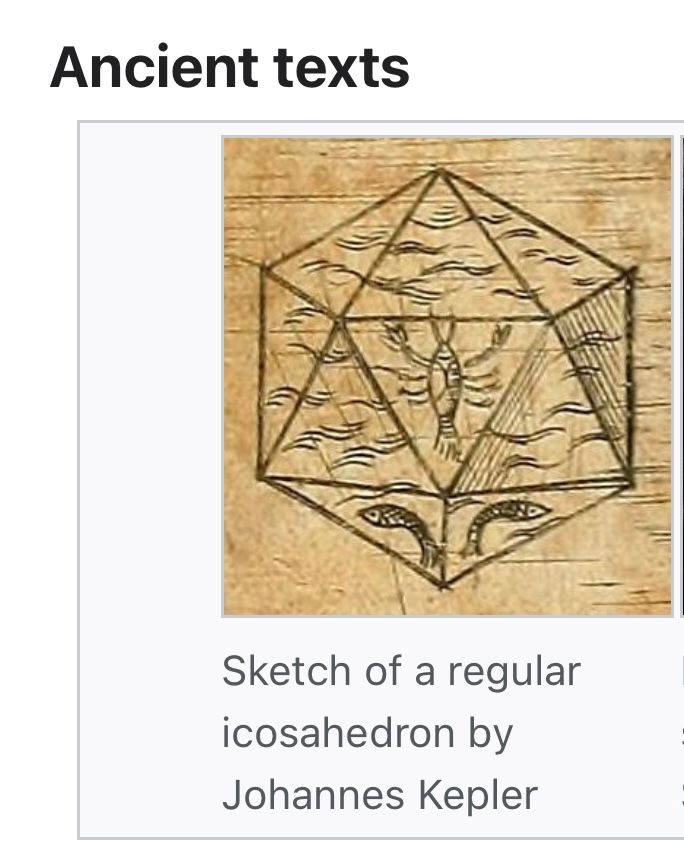
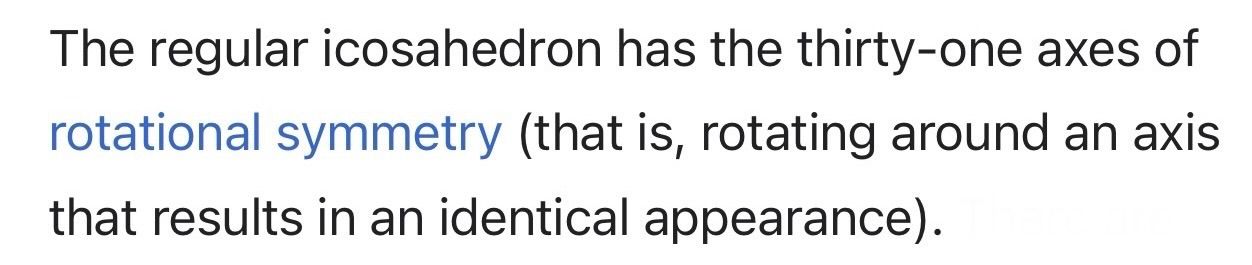
We do know, however, that the IMAGINARY MAXIMAL MOLECULE we diagramed in CONSTRAINT 4—the McMolecule with 12 First Responder Elements attached to the McCOM at the vertices of a regular icosahedron, perfectly solving the “kissing number problem”—would experience BALANCED ROTATION around BOTH the vertical axis AND the horizontal axis, and along many SIDEWAYS AXES as well!
According to Wikipedia:
The End of CONSTRAINT 5!
⛓️ CONSTRAINT 6. To ensure UNIFORM MASS DISTRIBUTION (which is necessary to guarantee UNIFORM McMOLECULE RESPONSE to EQUIVALENT EXTERNAL FORCES that are EXPERIENCED BY INDIVIDUAL FIRST RESPONDER ELEMENTS), the McMSPs in a McMolecule must be EQUAL DISTANCE APART and MAXIMALLY SEPARATED, so that no Element in the McMolecule is any *closer to kissing* than any other, which gives us two additional pieces of information:
(i) in ONE HALF of the McMolecule, the McMSPs must be in the same Circle of McCOM SHELL (a Circle of McCOM SHELL is defined as a circular cross-section of the McMolecule sliced perpendicular to the AXIS OF BALANCED ROTATION, having a CENTER that is a certain DISTANCE—between 0 and the radius of the McMolecule— away from the center of the McCOM, which means that a Circle of McCOM SHELL will ALWAYS DEFINE AN ANGLE RELATIVE-TO THE AXIS OF BALANCED ROTATION, and THE ANGLE of a Circle of McCOM SHELL can be determined by envisioning a line between the CENTER OF THE McCOM and any point on the SURFACE OF THE McMOLECULE corresponding to a direction/degree on the Mc SHELL/Compass that is within the Circle of McCOM SHELL, then finding the angle between that line and THE AXIS OF BALANCED ROTATION);
and
(ii) if McMSPs are in Circles of McCOM SHELL in OPPOSITE HALVES of the McMolecule, then the Circles of McCOM SHELL must be EQUAL DISTANCE (assuming DISTANCE > 0) FROM THE CENTER of the AXIS OF BALANCED ROTATION
UNIFORM MASS DISTRIBUTION is necessary to ensure UNIFORM McMOLECULE RESPONSE to EQUIVALENT EXTERNAL FORCES that are EXPERIENCED BY INDIVIDUAL FIRST RESPONDER ELEMENTS.
To achieve uniform mass distribution, no Element can be any *closer to kissing* than any other, which means that McMSPs must be EQUAL DISTANCE APART and MAXIMALLY SEPARATED.
In the TOEWC, where ELECTRONS (and protons and neutrons) DO NOT EXIST, and we have to distribute McMSPs UNIFORMLY—while also guaranteeing that all Elements in the same McMolecule will always exactly fit within a Mc SHELL/Compass having a three-Element diameter (see CONSTRAINT 1) without kissing (see CONSTRAINT 4) in a manner that enables the McMolecule to experience BALANCED ROTATION around either the VERTICAL AXIS or the HORIZONTAL AXIS (see CONSTRAINT 5)—the locations at which McMSPs can be attached to the McCOM are automatically limited in two ways.
Limit (i), it will be NECESSARY for all McMSPs in ONE HALF^^ of the McMolecule to be in the same Circle of McCOM SHELL—which is defined as a being a cross-section of the McMolecule sliced perpendicular to the AXIS OF BALANCED ROTATION, with each Circle of McCOM SHELL having a CENTER that is a certain DISTANCE (between 0 and the radius of the McMolecule) away from the center of the McCOM—to account-for NORTH AND SOUTH HALVES OF VERTICAL McMOLECULES and EAST AND WEST HALVES OF HORIZONTAL McMOLECULES (see CONSTRAINT 5), so this also informs us that a Circle of McCOM SHELL will ALWAYS DEFINE AN ANGLE RELATIVE-TO THE AXIS OF BALANCED ROTATION, and THE ANGLE of a Circle of McCOM SHELL can be determined by envisioning a line between the CENTER OF THE McCOM and any point on the SURFACE OF THE McMOLECULE corresponding to a direction/degree on the Mc SHELL/Compass that is within the Circle of McCOM SHELL, then finding the angle between that line and THE AXIS OF BALANCED ROTATION.
^^NOTE that for now, we’re going to ignore McMSPs along the Horizontal Axis—i.e., in the Middle Circle of McCOM SHELL, which has a CENTER that is zero distance away from the center of the McCOM, and has AN ANGLE OF 90-DEGREES—because technically the Middle Circle of McCOM SHELL is NOT IN ONE HALF of the McMolecule or the other.
Limit (ii), if McMSPs are in Circles of McCOM SHELL in OPPOSITE HALVES of the McMolecule, then the Circles of McCOM SHELL must be EQUAL DISTANCE (assuming DISTANCE > 0) FROM THE CENTER of the AXIS OF BALANCED ROTATION.
Keep in mind that these two NECESSARY limitations MIGHT NOT BE SUFFICIENT to build a McMOLECULE; we have to consider whether ADDITIONAL CONSTRAINT(S) must be satisfied.
But we already NOTICE that theoretically, we could build either a VERTICAL McMOLECULE or a HORIZONTAL McMOLECULE—i.e., a McMolecule that would experience BALANCED ROTATION around the VERTICAL AXIS or the HORIZONTAL AXIS, respectively—by placing Elements at the exact vertices of a REGULAR ICOSAHEDRON, according to the solution to the “kissing number problem” (see CONSTRAINT 4.)
We ALSO NOTICE that we could, in theory, build either a VERTICAL McMOLECULE or a HORIZONTAL McMOLECULE by placing FIVE McMSPs in a PENTAGON configuration in ONE Circle of McCOM SHELL in ONE HALF of the McMolecule.
We FURTHER NOTICE that we have identified one reason why the TOEWC and conventional chemistry will generate similar MOLECULAR GEOMETRIES, to wit: the VSEPR theory IMPOSES A SIMILAR CONSTRAINT regarding a central atom having attached atoms that are EQUIDISTANT APART AND MAXIMALLY-SEPARATED.
Google AI explains the reason why:

The End of CONSTRAINT 6!